

El Nino: Impacts on Rural Livelihoods, Farming, and Pathways for Mitigation
-Kuntal Mukherjee, Integrator, PRADAN
This article, authored by Kuntal Mukherjee, was first published in Counterview and has been reproduced here with minor edits. Bringing together field observations, farmers’ experiences, and agricultural insights, it explores the challenges posed by El Niño to rural livelihoods and farming systems. The article reflects on the implications of changing rainfall patterns and highlights pathways for adaptation, resilience, and community-led responses in rainfed regions of India.
El Nino is a climate pattern that occurs in the Pacific Ocean. El Nino is characterized by the warming of sea surface temperatures in the central and eastern tropical Pacific, which can have significant impacts on weather patterns around the world.
During an El Niño event, there is often an increased rainfall in parts of South America, drought in parts of Southeast Asia and Australia, and changes in temperature and precipitation patterns in North America. El Niño events typically occur every 2-7 years and can last for several months to a few years.
Effects of El Niño on Rainfall:
The effects of El Niño are different in different regions of the world. Some of the major effects are mentioned below:
- Increased rainfall in parts of South America: During an El Niño event, there is often an increased rainfall in parts of South America, including Peru, Ecuador, and northern Brazil. This can lead to flooding and landslides in these areas.
- Drought in parts of Southeast Asia and Australia: El Niño can lead to reduced rainfall in parts of Southeast Asia and Australia, including Indonesia and the Philippines. This can lead to water shortages, crop failures, and forest fires.
- Changes in temperature and precipitation patterns in North America: During an El Niño event, there can be changes in temperature and precipitation patterns in North America. This can lead to milder winters in the northern United States and wetter conditions in parts of the southern United States.
Effects of El Niño in India, especially in central India:
El Niño can have significant impacts on the monsoon rainfall patterns in India. During an El Niño event, the monsoon rainfall in India tends to be below normal, which can lead to drought conditions and impact agriculture, water resources, and the overall economy. Some of the effects of El Niño on India are:
- Reduced monsoon rainfall: During an El Niño event, sea surface temperatures in the eastern and central Pacific Ocean become warmer than average. These changes alter atmospheric circulation patterns, often resulting in reduced rainfall over the Indian subcontinent. The consequent drought conditions can adversely affect crop yields, food production, and water resources.
- Higher temperatures: El Niño can also lead to higher temperatures in India, particularly in the northern and western regions. This can exacerbate the impacts of reduced rainfall and lead to heat stress, particularly for vulnerable populations such as the elderly and children.
- Impacts on agriculture: Agriculture is a major sector of the Indian economy, and reduced monsoon rainfall during an El Niño event can result in lower crop yields and food production. This often leads to higher food prices and can adversely affect the overall economy.
It's important to note that while El Niño can have predictable effects on the monsoon rainfall patterns in India, the exact impacts can vary from event to event and are influenced by other factors as well, such as the Indian Ocean Dipole and the Madden-Julian Oscillation.
So, the overall situation (both in doing and being) and the actionable steps could be:
- Dry spells may go on with sporadic low-patch scattered rains.
- Fields may not be totally empty and fallow, but the sown crops would have poor health with low chance of survival.
- Two-three inches tall broadcast-sown paddy may face significant weed competition and moisture stress in the root zone, which may result in yield losses of up to 30%.
- Farm inputs may be distributed and planned in farm steps.
- Farmers may try dry seed beds and maintain crops by providing water from outside, especially in irrigated plots.
- Vegetable nursery may be done also in water scarcity condition.
As because Paddy is the main crop of Kharif season and main paddy producing states are mainly in the central eastern parts of India, it’s important to understand the physiology of paddy:
-
The Vegetative Phase
The vegetative phase starts at seed establishment (germination) and ends at the onset of panicle initiation, during the late vegetative phase. The number of days in this phase varies according to different varieties. For example, the 120-day rice variety will have 55 days in the vegetative phase, while the 150-day variety may take 85 days. Further, low temperature or long day length can increase the duration of the vegetative phase.
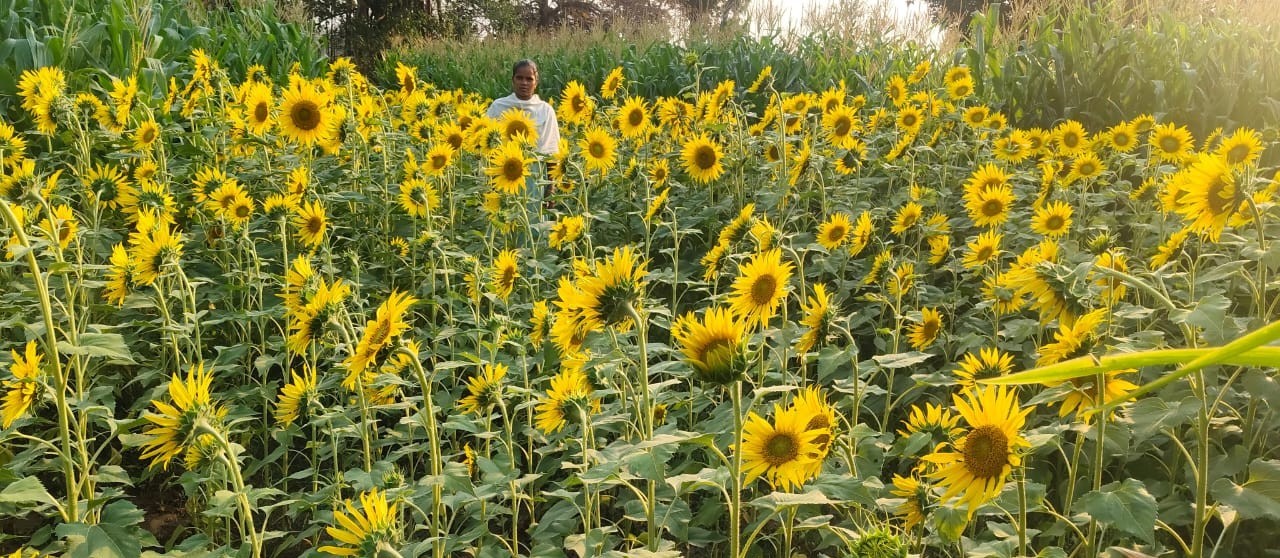
Representative image. The photograph is used to illustrate agricultural systems and rural landscapes discussed in the article
- ● The Reproductive Phase The reproductive phase begins at panicle initiation and ends at flowering, usually taking 35 days. At this phase, the plant is most sensitive to stresses such as low and high temperatures, and drought. The number of days in the reproductive phase and the ripening phase are the same among most rice varieties.
During this phase, the culm elongates, resulting in an increase in plant height, while the number of tillers declines and the flag (last) leaf emerges. This is also the stage when booting, heading, and flowering of the spikelets occur. Panicle initiation, that is, the stage at which the terminal shoot of the rice plant begins to develop grain, takes place approximately 25 days before heading, when the panicle reaches a length of about 1 mm and can be identified visually or under magnification following stem dissection. For the purpose of this article, this period has been approximated to three weeks in the table, although it may be adjusted, considering that a month consists of 30–31 days rather than exactly four weeks.
Flowering (anthesis) begins with heading or on the following day. Within the same panicle, it takes 7 to 10 days for all the spikelets to complete flowering; the spikelets themselves complete anthesis within 5 days. It takes 10 to 14 days for a rice crop to complete heading due to variation between tillers on the same plant and between plants in the same field. Heading is usually defined as the time when 50% of the panicles have headed.
- Ripening phase The ripening phase starts at flowering and ends at maturity. This stage usually takes 30 days. Rainy days or low temperatures may prolong the ripening phase, while sunny and warm days may shorten it.
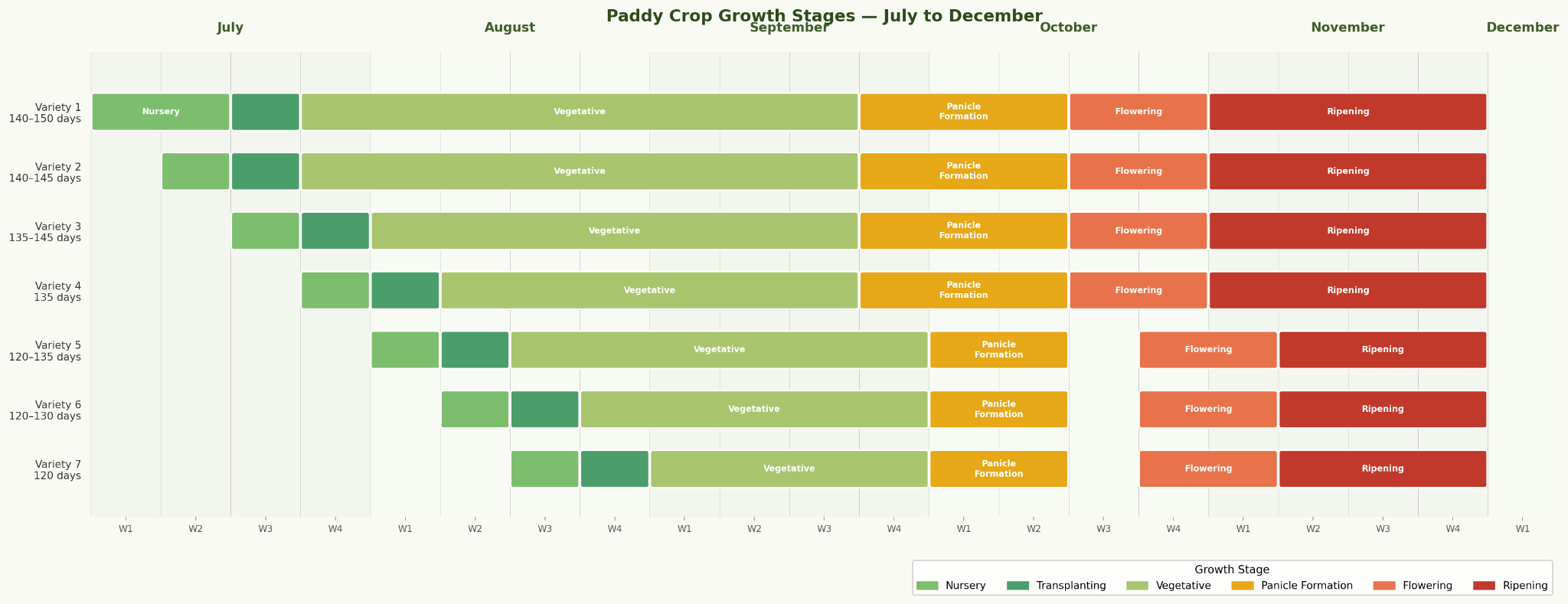
Temperature also plays a very important role in panicle initiation and emergence. For example, in the case of rice variety IR8, under controlled environment conditions was subjected to night temperatures of 15, 20 and 25°C during each of the three periods (a) sowing to floral initiation, (b) initiation to panicle emergence, and (c) panicle emergence to maturity, with day temperatures of 30°C throughout. Night temperatures of 15°C prevented floral initiation throughout the experiment (source: P. C. Owena, Division of Land Research, CSIRO, Canberra, Australia in 1999). This temperature sensitivity holds good for other varieties also. In this region night temperature starts falling below 15°C after the middle of October. So varieties need to be selected and nursery should be sown considering this factor so that panicle emergence is completed before temperature falls below 15°C.
Farmers’ traditional decision on selection of rice variety based on land type (basically moisture regime availability in lands) had been working well in the past with indigenous (deshi) (tall indica) type of rice, which were photo-period sensitive (varieties which enters reproductive growth (that begin with initiation of panicle) phase in response exposure reducing day-length. There are some early autumn varieties which initiate panicle formation in reducing day-length period (i.e. after 22nd-23rd of June – When Sun is perpendicular on tropic of cancer) but most of these varieties produce flowers only after exposure to less than twelve hours day-length (or actually more than 12 hours of night length - that happens after 22nd -23rd of September). The advantage of indigenous varieties is, farmers can plant those early; any time after winter and as late as September. Those varieties will flower only after it receives exposure to shorter (less than 12 hours) day lengths.
But, nowadays in many places farmers have entirely replaced the indigenous varieties with High Yielding Varieties (HYV) which are only temperature sensitive so far as their reproductive growth phase is concerned, but are not photoperiod sensitive. Rather these varieties need minimum time to complete vegetative growth phase before they enter the reproductive phase. Thus, a variety which requires 90 days to complete vegetative growth must complete those 90 days before 2nd or 3rd week of September (may vary from location to location within the same state or region itself) so that it gets 35 days for panicle initiation and flowering before the 15th or 21st of October. In a few instances the farmers reported good progress up to tillering but did not produce any panicle or panicle failed to come fully out of the boot leaf.
So, the consequences are:
Since the nursery raising is delayed and rains are sporadic and scanty, the transplantion of paddy will be delayed. If it rains well in July (200-300mm), the transplantation will happen in August, and the long duration high yielding variety (Mansuri, Swarna, 6444, 1010, Pankaj, Sita etc.) paddy can fail to flower in second fortnight in October in the areas where minimum temperature drops to 15°C. As these dwarf Japonica rice varieties are day-length insensitive but duration and temperature sensitive, they flower when their vegetative phase (80-85 days in case of 145-150 days and 55-60 days in 125-130 days duration varieties) is over. However if the temperature remains low at the time of flowering, they fail to flower. The indigenous tall indica rice (still grown in many villages) is day-length sensitive i.e. they flower when the day-length changes, regardless of their stage. So late sown long duration paddy may fail to flower.
Therefore, in this situation:
- Growing nursery for 140-150 days old HYV paddy in July third week is a risky affair.
- It is better to go for the traditional tall indica varieties in the lowland area, if done with SRI/DSR it will give high yields than long duration HYV transplanted late.
- The medium duration paddy in the medium uplands may also face the low temperature risk if transplanted in the second week of August, and it may also suffer from moisture stress in October if monsoon recedes normally.
- In the medium upland areas, farmers should also grow, shorter duration paddy varieties like, Khandagiri, Parijat, Vandana, MTU-1010, lalat or local/traditional seeds which mature in 100-125 days.
- It is also understood from above that “if the nursery period is shorter, the rice plant gets more time in the main field for vegetative growth, produce more tillers, so if it does not rain adequately in July/August, SRI/DSR system gives more opportunity to rice plants to produce more grains.
- There will be a competition for labor between paddy field operations and attending to the vegetables.
If the rains are not adequate for rice in the medium uplands, transplantation will not occur by 15th August, there is opportunity to replace the paddy with pulses/vegetables/millets to take residual moisture in mind because cynodon the seminal weeds is already there in low water content with dry high value biomass conserving organic matter.
Let’s look at the other effects:
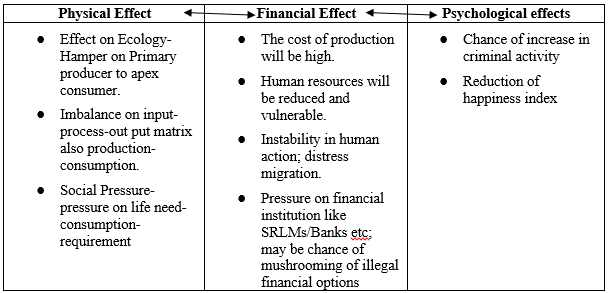
Some points of thinking based on mitigation and management can be think:
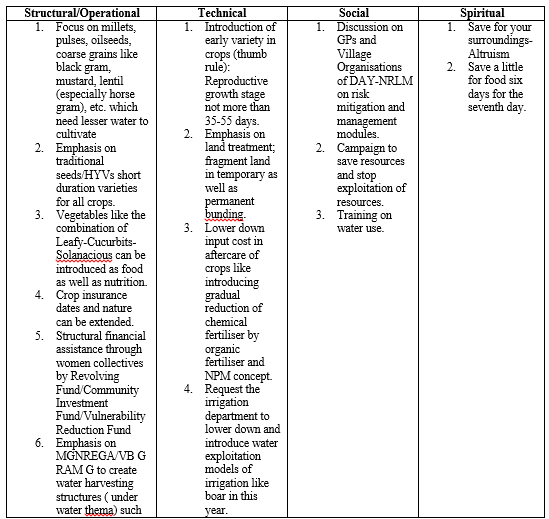
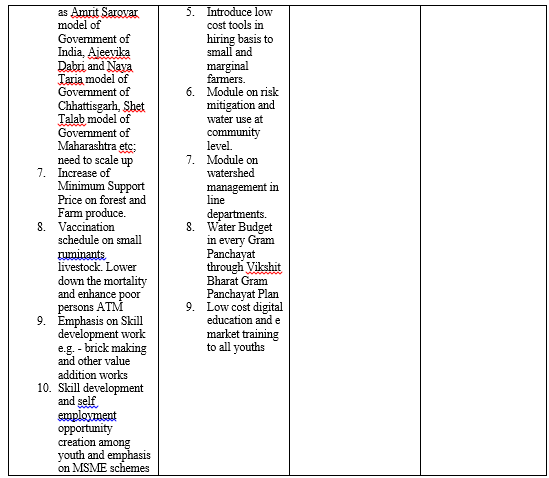
Other Mitigation Strategies Can be:
- Improving water management: During an El Niño event, there can be reduced rainfall in some areas and flooding in others. Improving water management strategies, such as increasing water storage capacity, can help mitigate the impacts of drought and flooding.
- Developing drought-resistant crops: Drought-resistant crops can help farmers mitigate the impacts of reduced rainfall during El Niño events. Planting drought-resistant crops can help ensure that farmers can still produce a viable crop even if rainfall is lower than normal. Side by side introduce and scale up of low water loving crops such as pulse, oilseeds, vegetables etc.
- Improving early warning systems: Early warning systems can help communities and governments prepare for the impacts of El Niño events. These systems can provide advance notice of reduced rainfall or flooding, allowing communities to take appropriate measures to protect themselves and their property.
- Developing heat stress management strategies: Higher temperatures during El Niño events can lead to heat stress, particularly for vulnerable populations. Developing heat stress management strategies, such as providing access to cooling centers and ensuring that outdoor workers have access to shade and water, can help reduce the impacts of heat stress.
- Investing in climate adaptation and resilience: El Niño is just one of many climate-related hazards that communities around the world are facing. Investing in climate adaptation and resilience measures, such as improving infrastructure and building more resilient communities, can help reduce the impacts of all climate-related hazards, including El Niño.
The Steps with village level collectives can be:
- Encourage farmers to immediately sow nursery with HYV low duration /local low duration seeds, using the CRP/CSP network, SHG Clusters, SHGs by meeting/ canvasing/postering/walling/ miking/letters etc. while discouraging them to sow Swarna and other long duration varieties and encourage them.
- Explore with ATMA/local market regarding availability of shorter duration crops seeds (Not more than 120 days), pulse and oilseeds seeds make them available to farmers.
- Influence convergence with collectives on Millets Mission, National Oilseed Mission, Natural Mission on Natural farming and Pulse Mission.
- Major focus needs to be on water conservation. Create opportunity of create water harvesting structures like farm ponds, amrit sarovar in individual and common land to conserve more water to create lifesaving irrigation
- Focus on river and rivulet treatments both on drainage line and area treatment
Conclusion:
El Niño is not merely a climatic phenomenon; for millions of small and marginal farmers across India, it can become a livelihood crisis. Delayed monsoons, prolonged dry spells, moisture stress, declining crop yields, rising production costs, and increased uncertainty place immense pressure on rural households, particularly those dependent on rainfed agriculture.
However, the impacts of El Niño need not translate into widespread distress if communities, institutions, and governments prepare proactively. The experiences and recommendations discussed in this article highlight the importance of timely crop planning, promotion of short-duration and climate-resilient varieties, diversification into pulses, millets, oilseeds, and vegetables, strengthening water conservation efforts, and investing in local water-harvesting infrastructure. Equally important are strong community institutions, effective extension services, robust early-warning systems, and convergence between government programmes and grassroots initiatives. As climate variability becomes increasingly frequent, the focus must shift from crisis response to long-term resilience building. Watershed development, sustainable natural resource management, local seed systems, risk mitigation planning, and community-led adaptation strategies will play a crucial role in safeguarding rural livelihoods.
The challenge posed by El Niño also presents an opportunity to rethink agricultural planning, strengthen local resilience, and promote farming systems that are better adapted to a changing climate. Through collective action, scientific planning, traditional knowledge, and institutional support, rural communities can not only withstand climatic shocks but also build a more secure and sustainable future.
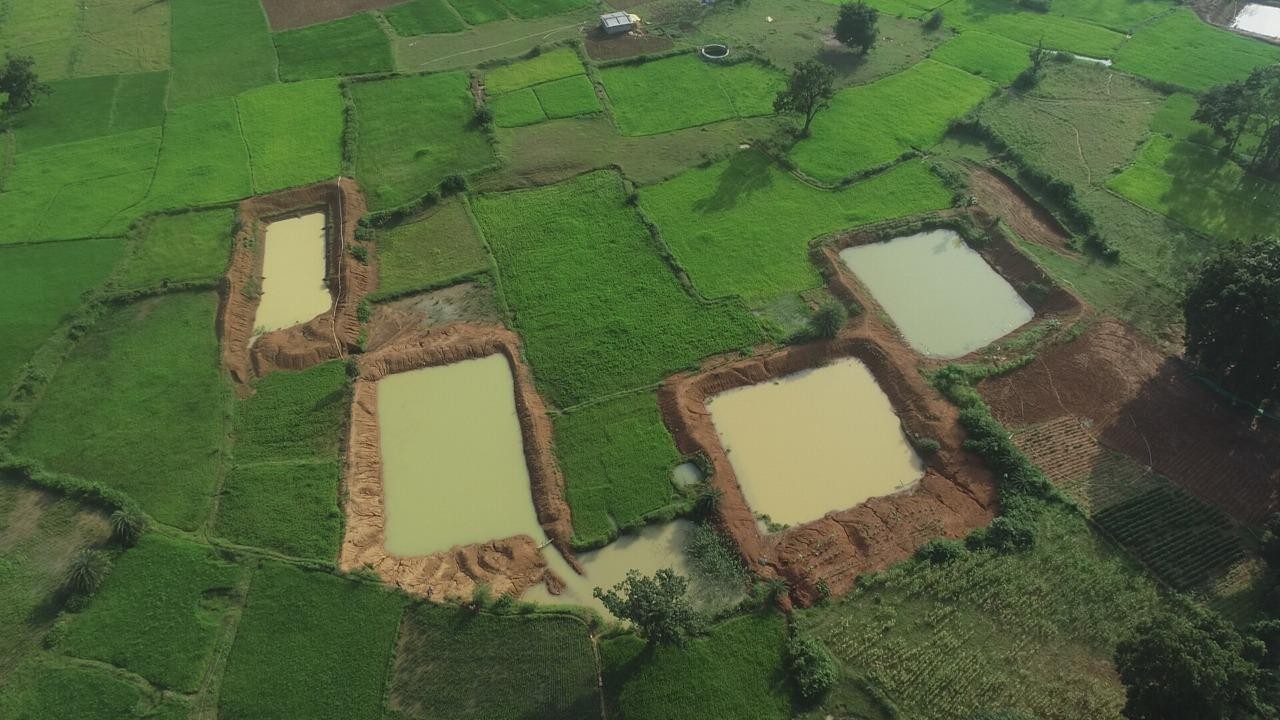
Representative image. The photograph is used to illustrate agricultural systems and rural landscapes discussed in the article
About the Author