

Designing for Ownership: Lessons from a Tool Bank Experiment
-Sattva Vasavada Sengupta, Executive, PRADAN
What creates real ownership in development initiatives; delivering assets, or involving communities in meaningful decision-making? Drawing from a tool bank experiment in Balaghat district, Madhya Pradesh, this article explores how process design, transparency, and participation shape women’s engagement, collective decision-making, and sense of ownership over community resources.
Development projects are usually evaluated by what they deliver: assets, services, or output such as improved productivity and/or higher income. The idea of development being “delivered” makes output and outcome-focused indicators more acceptable - “how much did you deliver?”. Over time, this method of understanding and evaluating development has been found limiting by many, and has led to the mainstreaming of participatory approaches in development projects.
On the same lines at PRADAN, evaluative judgements not only consider outcomes, but also the process through which outcomes are delivered - with a clear inclination towards participatory processes. This is because we believe that participatory processes are key to empowering people, especially women, by ensuring they play a decisive role in their own development. While both ‘delivery’ and ‘participatory’ development approaches have outcome-based evaluations, they differ in the way - the “process” - of how development was achieved. The way a project is implemented can strongly shape whether people feel genuine ownership over it, or whether they see it as something done to or for them rather than by them.
But what does this look like in practice? The experience of setting up tool banks in Balaghat district, Madhya Pradesh offers a useful lens.
What are Tools Banks?
Tool Banks, at the heart of it, are exactly what they sound like - bank of tools! More specifically, tool banks are created with the purpose of providing villages access to improved, productivity-enhancing agricultural tools that may not be widely available in their village. Tool banks in the Birsa block of Balaghat district in Madhya Pradesh are being funded by HDFC Bank Parivartan’s project WATER (2024-2027), which aims to double the intensity of agriculture by creating irrigation and agriculture-related assets. Other than the tool bank, the project's key deliverables include creation of solar lift irrigation sites, earthen dams, farm ponds, vegetable nurseries, trellis, etc in 25 villages of Birsa block, Balaghat district.
For creating tool banks, PRADAN’s team in Balaghat decided that we shall ask women farmers of villages what tools they would want to have in their village’s tool bank. Based on the choices they made, the tools will be procured and transferred to the Village Organisation (VO) consisting of women members. Tool banks fulfill two objectives - the VO members have some earnings in their names, and farmers also get access to improved agricultural tools for a low rental price. As discussed above, the process of creating tool banks can be pivotal in ensuring women farmers feel like they own the tool bank, rather than being only the managers of tools (which is also great!). While we were asking women to decide what tools they would want for their village, there were other things we wanted to try to increase women’s ownership of the tools they were deciding.
This article presents a process experiment conducted during the implementation of women-managed tool banks. A process experiment does not test a new product or technology. Instead, it deliberately changes the process design - that is, the steps, information, and decision rules used during implementation to see how these changes affect behaviour and feelings of ownership. Here, the outcome of interest was not which tools were selected, but whether women showed greater ownership, better decision-making, and stronger engagement when the implementation process treated them as responsible decision-makers rather than passive beneficiaries. The need for changes in process design stemmed from observations and reflections on decision-making processes in a few other tool banks. It seemed like women were interested, but were not participating and engaging with as much ownership as we would have expected otherwise.
Before describing the experiment, two key terms need clarification. Process design refers to how decisions are made during implementation: Who is given information, what information is shared (options, prices, budgets), when it is shared, and who is responsible for making the final choice. Most projects have a process design, whether explicit or implicit.
Secondly, ownership, in this article, does not mean legal ownership. It means whether people feel the resource belongs to them collectively, take responsibility for deciding how it should be used, think carefully about trade-offs, and continue to engage even after the asset is delivered (for example, by correcting mistakes). The experiment tested whether changes in process design could increase this kind of ownership.
The practical question behind the experiment emerged from a recurring, practical dilemma. To create each tool bank, the project had allocated a budget of Rs. 45,000 per tool bank. Funding for one tool bank with one women’s group is only utilised once, after which we move to a different village and create a tool bank with another women-led group. That is, each tool bank would be endowed with Rs. 45,000 worth of agricultural tools that they would manage. The dilemma - When asking women’s groups which tools they wanted, should the implementing team tell them the total budget and the prices of each item upfront, or not? Would this have any positive or negative impact on the ownership that women feel?
Some common concerns argued against disclosure:
- Women might focus on “spending money” rather than real needs.
- They might demand expensive items simply because the money is available.
- Price transparency could lead to jealousy or conflict.
- Communities might stop contributing their own resources if they knew we have a lot of funding.
Arguments in favour were equally strong:
- Without knowing costs, people cannot make realistic choices.
- Budget transparency enables prioritisation and trade-offs.
- Treating women as decision-makers builds confidence and responsibility
Rather than deciding in advance, we tested these assumptions through a small, structured experiment. To conduct the experiment, ongoing activities of creating tool banks under HDFC Bank Partivartan’s WATER project were targeted during April-May 2025. At the time of the experiment, three tool banks were being created in the Birsa block of Balaghat District. The only thing that changed was the decision-making process for selecting the tools.
1. In village 1- Adori (Control group)*:
- No list of options was shown.
- No prices or budget were disclosed.
- A facilitator asked what tools were needed and suggested quantities.
2. In village 2- Janpur (Treatment 1)*
- Women were shown photos and short videos of different tools.
- Tools were explained and discussed.
- Prices and the total budget were not disclosed.
3. In village 3- Dhamangaon (Treatment 2)*
- Women were shown the same options as in Janpur.
- Prices of each tool and the total budget were clearly disclosed.
- The budget was explicitly described as the group’s own money to allocate.
In the decision-making processes in each of the villages, the facilitator observed how women chose and took ownership of the decision-making process. Based on the type of decision-making process, timelines for decision-making would last anywhere between 15 minutes to 3 hours, with each meeting having a different number of participants.
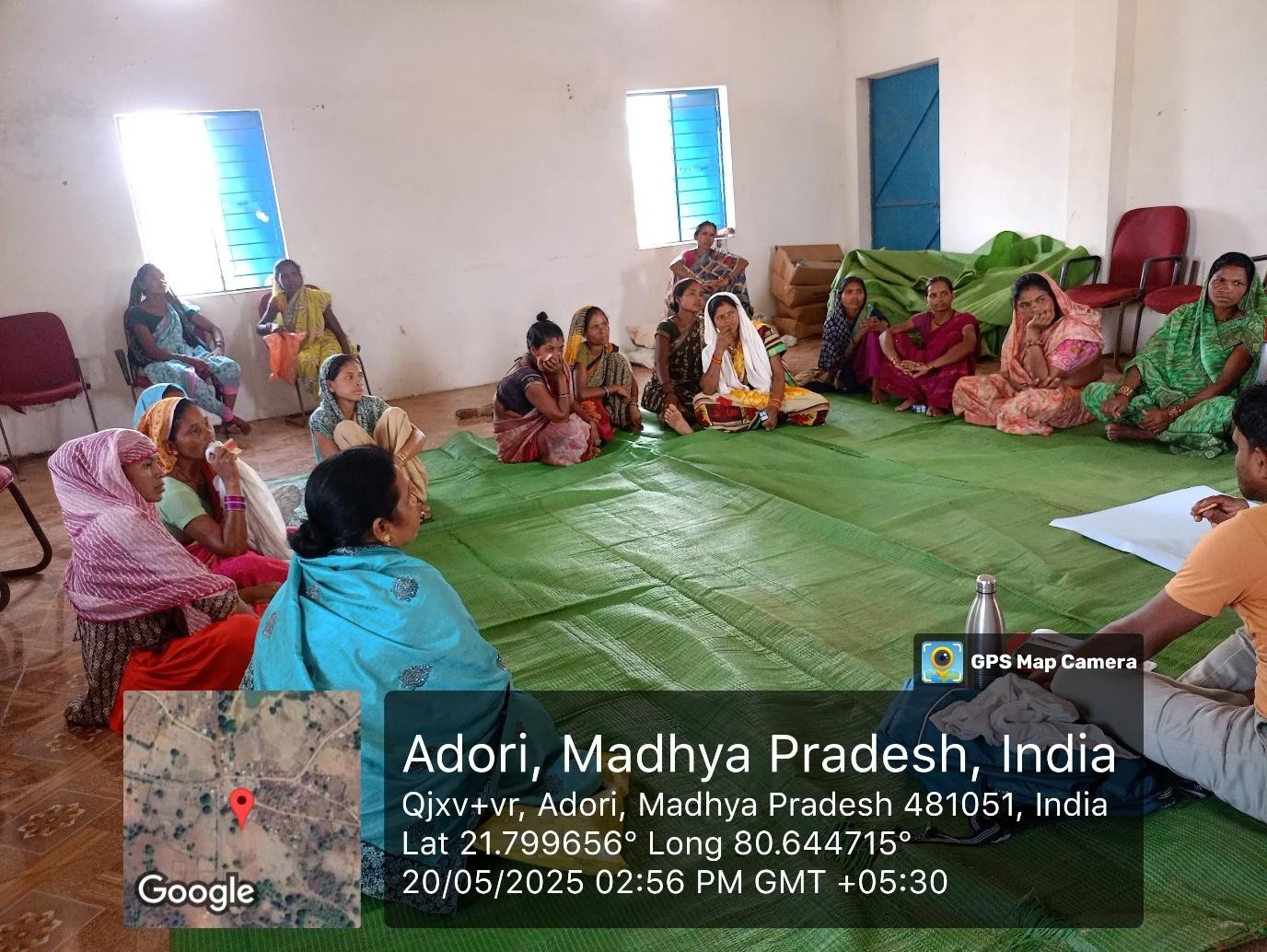
In Adori
In Adori, the decision-making process lasted less than five minutes. The facilitators, including the author and other colleagues, asked what tools would be useful. Out of 15 women who were part of the meeting, 1–2 suggested pumps and battery sprayers. The facilitator then asked if quantities—two of each (two water pumps, two sprayers), would be appropriate. “Yes, that works,” replied a couple of women, while most others nodded. The decision was finalised immediately: two 2-HP Honda irrigation pumps and two battery sprayers.
What was notable was not just the speed of the decision, but the absence of engagement around it. Women did not ask what other machines were available, what the tools cost, or how much budget was being allocated. There was no discussion on whether alternative tools might be more useful, nor any comparison across options. The decision was effectively shaped by a few voices, with the larger group passively agreeing.
This process was efficient in generating an output, but it remained superficial. There was no deliberation among women, no weighing of trade-offs, and no collective exploration of what would best serve their needs. On the day of delivery, the president of the VO, Unnati Gram Sangatha in Adori, Hemlata Bhautekar, noticed a power tiller on a transport vehicle and remarked that they had not known such a tool could even be chosen. This indicates that women did not have visibility of the full range of options available to them.
The absence of questions, discussion, or curiosity suggests that women were not engaging as decision-makers. Without access to information or a space for deliberation, the process did not encourage them to interrogate choices or take ownership of the decision.
Photo: Tool Bank- Tool Selection Meeting in Adori
In Janpur
Janpur introduced an important improvement. Ten women were shown pictures and videos of various tools. They asked questions about how the tools worked, and interest was generally high. Women were curious, especially about new tools like a paddy transplanter. However, prices and the total budget were not shared. Women were then asked to rank the tools they deemed important after being shown their different uses.
While curiosity was visible, it remained limited to understanding functionality. Women did not ask what the tools cost, how much budget was available, or whether choosing one tool would mean giving up another. There were no questions around trade-offs or affordability. Decisions were made based only on the information presented, without probing what was missing.
Several women quietly left, leaving only ~20% of participants in the meeting. This is a repeated issue that many field teams face, women are often balancing multiple responsibilities, the purpose of meetings may not always feel clear, or the engagement may not sustain interest. In this case, the video showcasing session appeared long, and when women were asked to rank and decide tools, the meeting seemed to extend beyond expectations. With other priorities taking over, many women left, leaving the final ranking to be completed quickly by a small group of 2–3 VO leaders.
A key reflection from the process was that the facilitators had not been able to create sufficient ownership among the women participants. Sustained engagement often emerges when people feel that the process genuinely belongs to them and that their participation meaningfully shapes the outcome. In retrospect, while the meeting was designed with participation in mind, the facilitation did not adequately translate the exercise into something the women felt deeply invested in.
The session also revealed how important pacing, clarity of purpose, and facilitation style are in community processes, especially when participants are balancing multiple responsibilities and limited time. The video screening and subsequent ranking exercise may have felt lengthy and externally driven, rather than interactive or immediately relevant to their lived priorities. As a result, attention gradually declined, and participation narrowed to a small group of VO leaders who completed the exercise.
This became an important learning: participatory tools alone do not guarantee participation. Greater effort is needed to build ownership from the outset, make the purpose more tangible, and design facilitation processes that sustain energy, relevance, and collective involvement throughout the exercise. These learnings were further incorporated into our experience with women community members in Dhamangaon.
The final list of tools in Janpur included one manual paddy transplanter, one line weeding instrument, one brush cutter, and two battery spray pumps. Problems emerged later. The paddy transplanter turned out to be expensive and consumed much of the budget, which meant that some lower-ranked tools like the power tiller and weighing machine could not be purchased.
Once the tools were delivered and women saw tools being delivered to other villages, such as water pumps and a mini power tiller, the president of Adharsh VO, Meena Baghel, asked if they could also get those. The facilitator reminded them that these had been ranked lower. When asked why they had not prioritised them, she responded:
“We would have adjusted our demand according to the budget and prices” (Meena Baghel, President of Adharsh VO, Janpur)
Janpur shows that providing options without sharing costs leads to incomplete participation and partially informed decisions. While women engaged with the tools at a functional level, the absence of cost information meant that decisions were not grounded in real trade-offs.
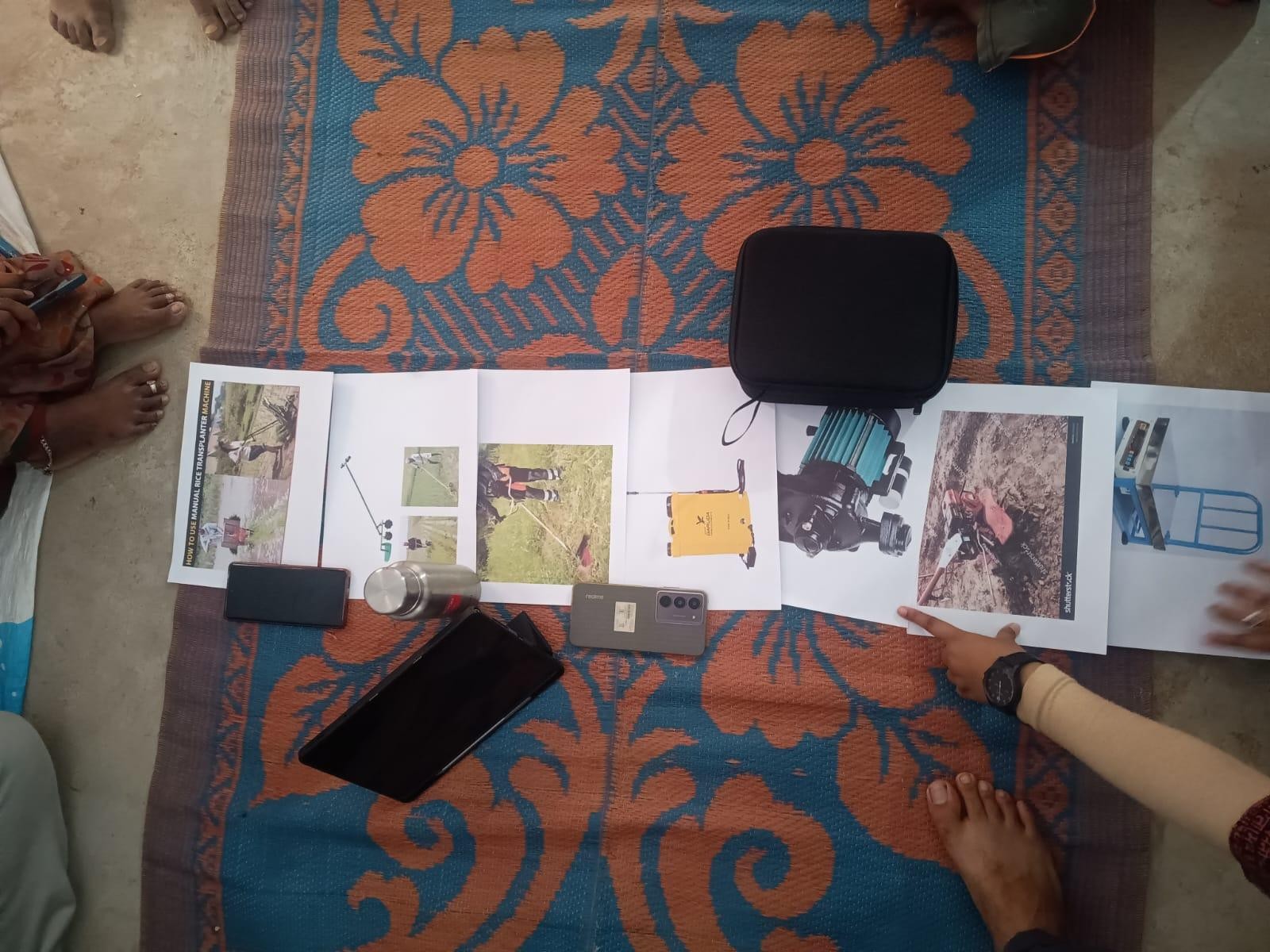
Photo: Janpur Tool Bank- Preferred Tool Ranking (Top is the most preferred)
In Dhamangaon
Dhamangaon differed in one critical way: women were told both the prices and the total budget upfront. The budget was described as a fund they had to spend to purchase agricultural tools for their village level collective. The reaction was immediate. Women laughed, paid attention, and stayed engaged. The facilitators also mentioned that the meeting may take time, to which a woman remarked: “We will stay here for two hours to decide what to do!”. Almost all women sat through the entirety of the decision-making process (~80%), a stark difference from the previous two tool banks where women did not seem very interested. A field staff that was present there with the facilitator even remarked that they seemed very interested in the selection process – something that had not been seen in previous tool banks. Once the videos were seen, women were given a free hand in deciding what and how much of the tools they wanted – they just had to get all units and prices within the budget. For around 30 minutes women engaged in a discussion. They kept asking the facilitator to play videos of different machines during the discussion. Most women participated actively, the facilitator did try to increase participation from those who were not talking, but refrained from very active facilitation, because the baton had been handed over to the woman collective.
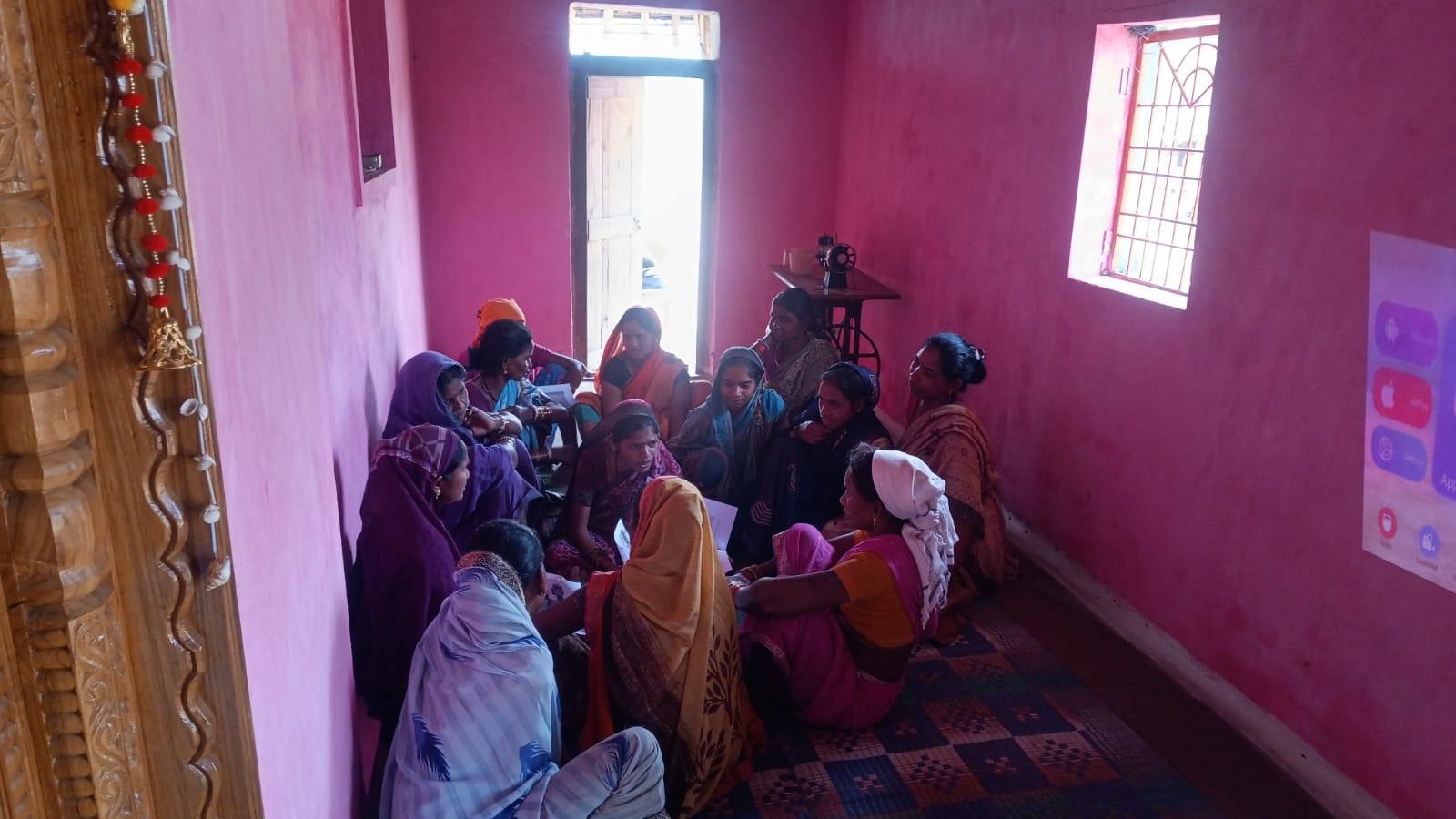
Photo: Dhamangaon Tool Bank Deliberation
First, women had initially selected the same paddy transplanter as Janpur. They asked to watch the video of the transplanter again, post which they again discussed and ruled it out as an option. They themselves decided that it would not be of much use in their village. Very few people possessed flat land where the transplanter could’ve been used. They explicitly said “in the same cost (as the paddy transplanter), we can get 1 mini power tiller and 1 brush cutter”. They replaced it with a combination of cheaper tools that fit the same budget. Women discussed the trade-offs. One younger participant asked whether another item could be added if transport costs turned out lower. Rather than accepting the tools passively, they evaluated it and sought corrections wherever necessary. This behaviour signals strong ownership. Women acted like people spending their own collective money.
What the Experiment Tells Us
Two clear lessons emerge. First, ownership grows when people are trusted with responsibility. This sense of responsibility is shaped by how decision-making processes are designed. When women were given full information and real choices, they acted thoughtfully and seriously.
A critical marker of this shift was the nature of participation itself. In the first two villages, women did not ask questions about costs, budgets, or alternative options. Their engagement remained limited to responding to what was presented to them. Decisions were made quickly, often by a few voices, without collective deliberation. The absence of questions reflected the absence of ownership, women were not positioned, nor did they position themselves, as decision-makers.
In contrast, in Dhamangaon, questions, discussions, and negotiations became central to the process. Women asked for videos to be replayed, reconsidered earlier choices, and discussed trade-offs within the available budget. Decision-making became slower, more collective, and more deliberate. The presence of questions here was not incidental, it was a sign that women were engaging with the process as owners of the decision.
Second, better decisions require three conditions: time availability, option disclosure, and budget and price transparency. The longest and most complex discussions happened where budgets were disclosed. The highest ownership was observed in the tool bank where photos, videos, and cost information were all shared upfront.
A key challenge was convincing some members of the team to disclose machinery and budgetary information to women farmers beforehand. There were concerns that women might gravitate towards expensive tools, share information in ways that could create conflict, or misuse the knowledge of costs. These concerns reflect a deeper assumption, that communities may not be able to make responsible decisions if given full information. However, the experience across the three tool banks challenged this assumption. Women did not act irresponsibly; instead, they demonstrated greater interest, engagement, and care in decision-making when trusted with complete information. One facilitator present in Dhamangaon remarked after the meeting that women showed greater interest when they were provided with all the information.
This points to a broader shift in development practice. Traditionally, practitioners have often decided what communities need based on their own experience and field understanding, sometimes assuming that communities may not be able to make such decisions themselves. This experiment suggests a different approach: when communities are given the right information and space, they are not only capable of making decisions, but of making better, more contextually grounded ones.
Experience from this experiment shows that ownership is not created by delivering assets alone. It is created through decisions, and through the way those decisions are structured during implementation. Transparency about budgets and prices does not undermine participation; when framed correctly, it strengthens it.
*The term “control group” refers to the village where the usual process was followed without any changes. “Treatment” groups refer to villages where specific changes were introduced in the process to observe how they influenced participation and decision-making.
About the Author