The Things We Cannot Document
On the quiet transformations that happen beyond meetings, indicators, & outcomes, and the love that makes the work worth returning to
-Navleen Kaur, Executive, PRADAN
Every year, during Poshan Maah, traditional food recipe competitions create spaces for communities to celebrate their food, knowledge and culinary traditions. This year, the PRADAN team in Lohardaga joined tribal communities in Senha and Kuru blocks of Lohardaga district, Jharkhand, to mark the occasion.
In Bansari village of Murki Torar Gram Panchayat, members of the Oraon tribal community came together with traditional dishes and recipes. As people shared their food, conversations naturally turned to local ingredients, people's understanding of their nutritional benefits, and the food practices passed down through generations. These activities create spaces for people to share experiences and learn from one another.
For me, this gathering was more than an opportunity to talk about nutrition. It was a reminder of something I have come to understand through my work at PRADAN: sometimes, the most meaningful moments are those in which I am not the one sharing knowledge, but the one receiving it.
Observed every September under POSHAN Abhiyaan by the Ministry of Women and Child Development, Government of India, Poshan Maah brings renewed attention to nutrition through community-led activities across the country. From Anganwadi sessions and health check-ups to discussions on breastfeeding, complementary feeding and locally available foods, the month creates opportunities to connect everyday food practices with conversations around better nutrition.
In Lohardaga, the traditional food recipe competition has become one such occasion. Over the past two years, it has become a gathering I look forward to, not just for the food, but for the moments of learning, sharing and simply being together.
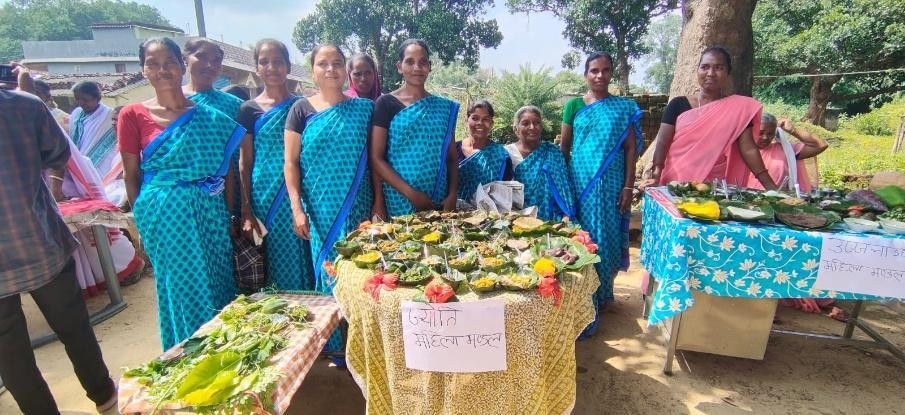
Photo: Community members with traditional food recipes to celebrate Poshan Maah
In my everyday work, I move between different roles. Sometimes I facilitate conversations; sometimes I listen, observe or share what I know. And often, I find myself learning from the people I work alongside. It is a relationship that grows through these exchanges and through the understanding we build over time.
But this particular gathering has come to mean something different to me. It is a chance to pause, sit among the didis and simply be. To listen, share a meal and experience the warmth of a community I have come to know over the years.
It feels like a festival of food, knowledge, togetherness and love. A day when, for a few hours, there is nothing to facilitate, no agenda to follow and no outcome to chase. Just people coming together.
The food, the stories and the people
Every year, there is a moment during these celebrations when I find myself listening to the community members with a sense of pride and wonder. They begin telling me about the foods they have brought, the greens they have learnt to include in their meals and what they have come to understand about their nutritional value.
“ई साग आहे दीदी, ई तोहर पूरा शरीर के स्वस्थ रखे बर अच्छा आहे ।”
“ई पेट के ठीक रखे बर आउर पेट के ठंडा रखे बर अच्छा आहे ।”
“ई एकर बर अच्छा हे, आउर ऊ दोसर चीज बर अच्छा आहे ।”
“This is the saag, didi. It is good for your overall health”
“This one is good for keeping your stomach calm.”
“This one is good for this, that one for that.
And I listen.
What follows is less a list of recipes than an act of remembering. The women speak of phutkal saag, traditionally used for digestion and stomach-related discomfort, and kalmi saag, which they recognise as a source of iron and vitamin A. They talk about kohrapatta saag, tesu phool, sunsunia saag, along with munga saag, koinar, chakod, lal saag and bathua.
These are foods that have grown around them for generations, some in their fields and others in the kitchen gardens they tend. Yet, in the course of these conversations, I begin to realise how much there is to discover even in the most familiar things.
One such discovery is ghorakanta saag, also known as kullekhara saag. The women tell us that they had always seen it growing in their paddy fields but had never quite understood its value. And after getting to know about it one of the training sessions, they drank the liquid concoction. And also, after eating it a few times, some felt more energetic and noticed that their stomachs felt lighter. Something they had walked past for years had become a food they now chose with intention.
It is a small moment, but one that stays with me. It reminds me that the mentioned food or knowledge does not always arrive from outside. Sometimes, it has been growing beside us all along, waiting to be noticed, trusted and shared.
And then comes the moment when I have that little leaf bowl in my hands.
The community members are excited to share with me, to tell me about what they have made, why they have made it, what they believe it does and how they learnt to prepare it. There is so much they want to share, and I find myself taking it all in, one bite at a time.
Honestly, I don't always know what to say. I just taste.
And truth be told, sometimes it is so overwhelming that it spills out through my eyes.
Because how do you explain that everything, they have made carries so much love?
The love that goes into a meal
The preparation begins long before we sit down to eat. Some women start a day in advance, while others wake up at first light and walk to the edges of their fields and kitchen gardens to pick the saag, still wet with dew.
Every member of the Self-Help Group (SHG) takes part, each in her own way. Some wash and chop the leaves, some grind spices on the sil-batta (grinding stone), while others tend the wood fire under the iron kadhai. Garlic crackles in mustard oil, the greens go in, and slowly, the whole courtyard begins to smell of home.
There is laughter, teasing and arguments over how much salt is enough. With every pot and every dish, the excitement builds.
But there is also so much conversation around the food. What is this leaf called? Where does it grow? When do you eat it? What is it good for? The answers never arrive as a list. They come as a flood of names, places, experiences and laughter.
Charhi saag. Jhagar saag. Puskanji saag. Chind ledra saag. Padri saag. Chana chur saag, which some call gajra ghaas. Sunsunia saag, tangy like amchur, which they say helps with sleep. Bitter karwa saag, eaten after Holi, often prepared as a bharta with steamed tomatoes.
Many of these are leaves I might once have dismissed as ordinary grass. These women do not.
Ask what these leaves contain, and the answer is simple: all kinds of vitamins. Ask which vitamin is found in which leaf, and they may not have a specific answer. But ask what to eat when sleep will not come, or when the stomach feels upset, and they know exactly what to recommend.
This is nutrition as they understand it. Not necessarily through nutrients, numbers or scientific names, but through the leaf, the season, the body and years of experience. Their knowledge is rooted in what grows around them, what they have eaten and what they have learnt from the women before them.
At one point, someone mentions that padri saag makes you pass wind, which is how it got its name. The entire circle breaks into laughter, and I laugh along, feeling, for a moment, like one of their own.
Soon, the conversation moves to memories. This is what we ate at my mayka (mother's home). That is what my nani (maternal grandmother) used to make. Another remembers a particular preparation from her childhood.
"हमरे के गाँव-देहात में कोइयो चीज़ के कमी नहीं होयेला, सब दिन कुछ ना कुछ खाए मिलेला।" (There is nothing lacking in the village, didi. There is always something to eat), one of them tells me.
Knowledge here is not always kept in books or passed down through formal lessons. It lives in kitchens, in recipes repeated over the years, in the taste of a particular leaf and in the memory of where it was eaten and with whom.
But the plate in front of today's children is not necessarily the plate these women remember.
Food habits have changed. Rice has become a staple in many households. Noodles, biscuits and packaged cooking oil have found their way onto the shelves of village shops. Children increasingly ask for what they call shop food. There is also less time to gather, sort and prepare seasonal greens, while migration and changing household arrangements have altered the everyday rhythms of cooking together.
Even grains like madua (ragi) have, at times, been pushed to the margins, dismissed as dark or associated with food eaten by poorer households. Gradually, foods that were once part of everyday diets have become less visible, while packaged and easily available alternatives occupy more space in household kitchens.
What grows around us, and what generations have known how to prepare, can slowly become something we stop noticing.
Yet, the older plate has not disappeared. It returns in conversations, shared memories and gatherings such as these. Through traditional food competitions and discussions in SHG meetings, women are bringing these recipes and the knowledge around them back into everyday conversations. They are naming the greens, sharing ways of preparing them and remembering foods that may have slowly slipped out of their kitchens.
Perhaps that is what makes these gatherings so special. A leaf once dismissed as ordinary grass becomes something worth knowing. A recipe associated with an earlier generation finds its way into a new conversation. Food that was once looked down upon becomes a source of collective pride.
And sitting there, watching it all unfold, I find myself thinking about how much love goes into a meal. Not just in the food itself, but in the time, the effort and the joy of making something together.
How do you explain that, for those few hours, it doesn't matter what you are going through, what your mind has been carrying, how tired you are or what has been breaking you a little?
It all just vanishes.
Everything softens, and what remains is us.
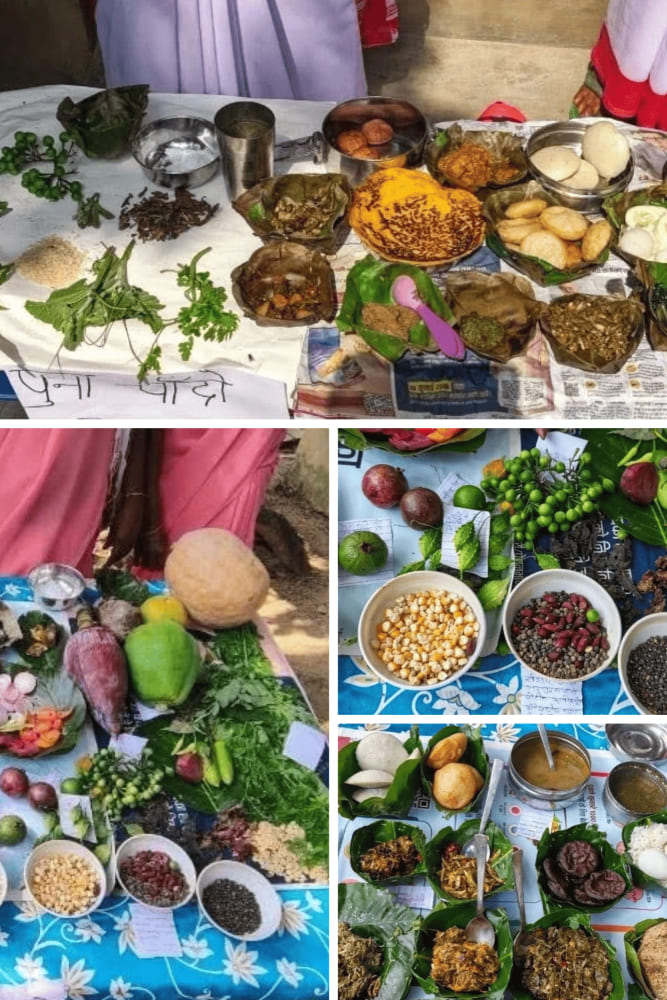
Photo: A display of different food items at the celebration
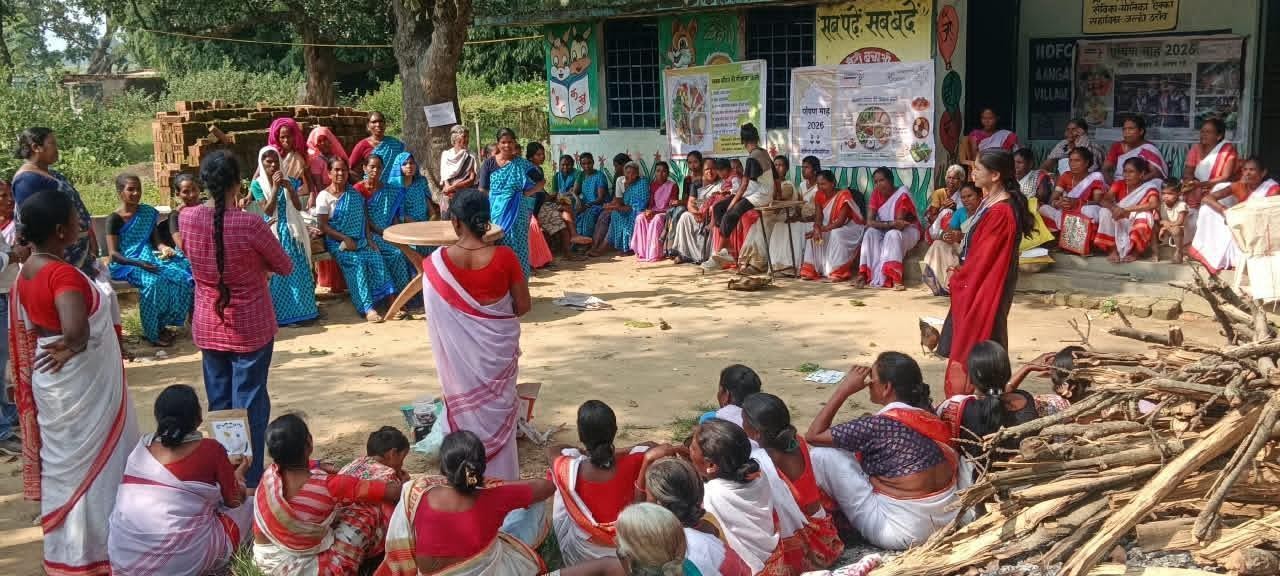
Photo: Women discussing local food traditions.
And perhaps, that is the essence of my work. Not always the things we teach, the awareness we generate, the meetings we conduct, the plans we make or the outcomes we document. Sometimes, it is these little shifts. This co-travelling. This becoming a little less of a giver and a little more of a receiver.
It is not always rosy. Work can be excruciating at times. There is the tiredness of long days travelling on rough, uneven village roads, late meetings that extend beyond sunset and living far away from home. There is also a quieter fatigue that comes from watching change unfold slowly, from seeing weeks of trust-building undone by a death, heavy rain or the pressures of daily wage work.
I carry home the hardships of the families I work with, long after the meeting is over. And when targets and field realities pull in opposite directions, when effort does not translate into visible results, I find myself questioning whether I am making any difference at all.
Yet, somewhere along the way, my understanding of what it means to share knowledge has changed.
I go to the field thinking I have something to share about nutrition. I did not expect to find so much of it already here.
My own habit is to buy whatever saag the market offers and cook it without a second thought. The community members, on the other hand, walk to the fields, gather what the season offers and know why they choose one leaf over another. They may not always speak of iron, vitamins or other nutrients in the language I have learnt, but they know what to eat, when to eat it and what different leaves are traditionally believed to do for the body.
They know without counting. I count, and sometimes realise how much less I know.
It makes me wonder how often we mistake the absence of scientific terminology for the absence of knowledge. What the women carry is not necessarily knowledge waiting to be taught, but knowledge that has been lived, practised and passed down over generations.
I have come to see that my role is not always to bring knowledge into a community. Sometimes, it is to listen closely, recognise what is already there, create spaces for it to be shared and help it travel further, including to the children who are growing up with increasingly different food habits.
And what I receive in return is far more than recipes. It is a different way of looking at food, at learning and at my own work. A reminder that some of the most meaningful knowledge does not always come from books, training sessions or formal conversations. Sometimes, it has been sitting in village kitchens all along, waiting for someone to listen.
These conversations have also made me look at health and nutrition a little differently. In taking conversations about food, nutrition and well-being into communities, I have had to confront how little of that care I was extending towards myself.
Like many of us, I found myself talking about eating well, eating on time and taking care of one's health, while not always practising the same in my own life. There were days when I would go for long hours without eating properly, postpone meals or simply eat whatever was available whenever I found the time. It was not always because work was too demanding. Sometimes, it was the pace of life, the things on my mind and the many little priorities that kept finding their way ahead of my own well-being. Somewhere in between, looking after myself became something I would get to later.
It took falling ill for me to pause and recognise this disconnect. I began to think about how easily we extend concern outwards, encouraging others to make healthier choices while overlooking the small, everyday choices that shape our own health. I had been speaking about nutrition, but was I really listening to what my own body needed?
It was a humbling realisation. Health is not built through awareness alone, nor is nutrition simply about knowing what is good for us. It is also about the everyday practice of making space for ourselves: eating when we need to, resting when our bodies ask us to and recognising that our well-being cannot always be postponed.
I do not think I have figured it all out. Even now, it remains something I am learning to practise. But falling ill made one thing clearer: the conversations we take into the community must also find a place in our own lives. Perhaps that begins not with getting everything right, but with recognising where we, too, need to begin.
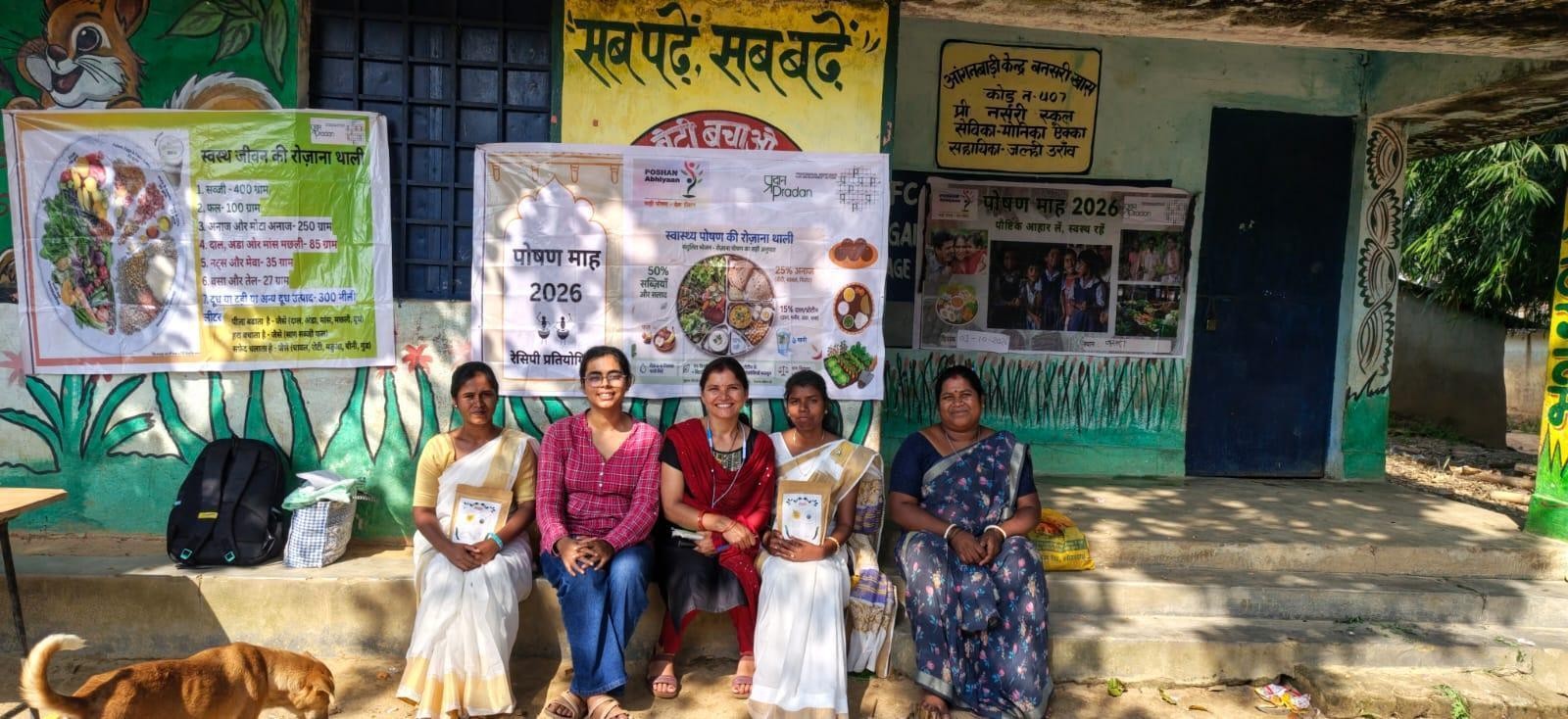
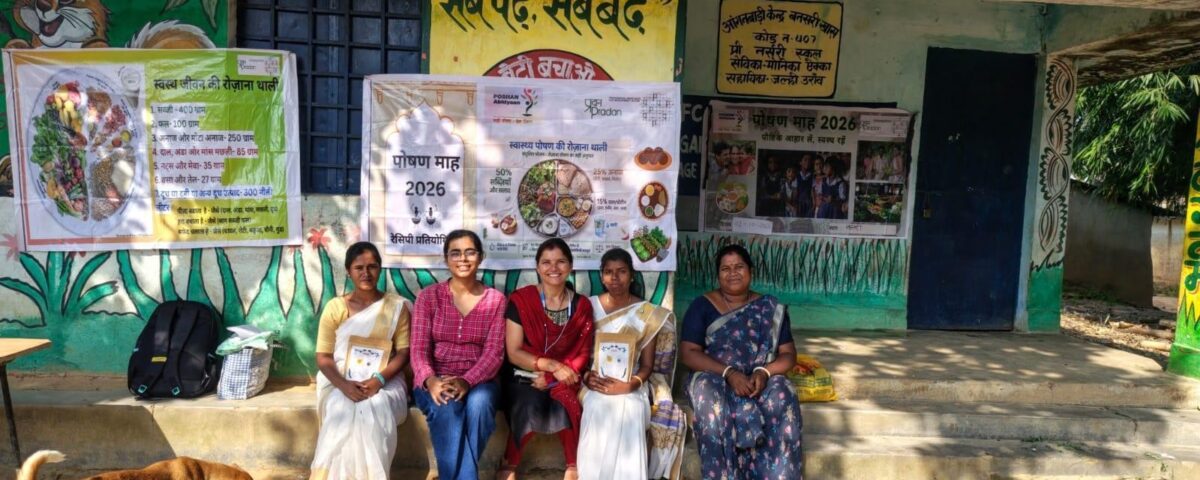
Photo: Navleen Kaur with community members.
There are days when didi offers me a cup of tea or shares a small success. In that moment, I am reminded of why I began.
And there are days when I sit with them, hold a little leaf bowl in my hands and eat something made with love. I realise that somewhere along the way, something has shifted.
Over time, I have also been fed, taught and held by the people I work alongside.
Perhaps that is what it means to be part of a community. Not simply to work with people, but to grow alongside them, to learn from them and to find a place among them.
And in those moments, I feel calm.
Happy.
Grateful.
And deeply, deeply held.
About the Author