
Companions in the Thick and Thin – What the Samuday Sathis Taught Me About Mentoring
-Parijat Ghosh, Team Coordinator, PRADAN
Mentoring is not about having all the answers. It is about listening, building trust, staying alongside someone through setbacks, and eventually knowing when to step back. Drawing from her experience with the Samuday Sathis of the UPRP project in Jharkhand, Parijat Ghosh reflects on how their everyday work reshaped her understanding of what meaningful mentoring can look like.
PRADAN, as an organisation, values and intends to nurture mentoring relationships within the organisation.
Over the course of my two-decade-long stretch in PRADAN, I have encountered the word ‘mentor’ countless times. Putting the mentee first; developing a relationship of mutual trust and respect; setting clear and challenging goals; guiding through feedback and support; and nurturing empowering relationships have been some of the principles of mentoring that I was taught over the years. However, I did not expect a research assignment to enrich the way I understand mentorship by allowing me to see all these principles in practice.
That is what happened when I spent time understanding the experiences of the Samuday Sathis, the community coaches of the Ultra Poor Responsive Panchayat (UPRP) project in Jaridih Block, Jharkhand. The project focused on extremely vulnerable households (EVHH) who are often left out of mainstream livelihood interventions.
Who are they?
The UPRP project was a 35-month pilot implemented across four gram-panchayats — Bhaski, Beldih, Chilgada, and Tandbalidih in Jaridih Block of Bokaro district, Jharkhand, in collaboration with Trickle Up. It was designed around the Ultra Poor Graduation Approach (UPGA), which combines household-level coaching, livelihood planning, asset linkage, and governance integration to support the most vulnerable families in overcoming persistent vulnerabilities and barriers to accessing livelihoods and entitlements.
Within this design, a Samuday Sathi was the frontline human bridge, the person who showed up at the door, built trust over months, sat with families to plan with them, and navigated panchayats and government departments on their behalf. The term ‘Samuday Sathi’ translates literally as ‘Community Companion’ or ‘Community Coach’, as used in the project
As part of the concurrent evaluation study, I spent time with the Samuday Sathis, listening to their experiences of working with some of the most vulnerable families in their panchayats. Our conversations took me beyond questions of what their role was, how they were trained, and what processes they followed. As they spoke about their work, the families they had struggled to reach, the relationships they had built, what had worked, and what had not, I began to get a sense of what it actually meant to be a Samuday Sathi.
There were eight women Samuday Sathis across four panchayats in the project, each supporting roughly fifty households. They had been selected by the village bodies, based largely on their social connect: women who were known in the community, had demonstrated engagement with self-help group (SHG) activities, and were willing to work closely with the most vulnerable households in their panchayat.
Throughout the project, the eight Samuday Sathis stayed in regular touch with the families they supported. Together, they helped around 400 families acquire Aadhaar cards, ration cards, disability certificates, and other documentation; the paperwork that often stands between a person and the welfare provisions they are entitled to. They also supported 18 to 36 families each with some form of livelihood support, including backyard poultry units, goat rearing, kitchen gardens, and petty shops.
Putting the Person Being Mentored First
The most important thing I was taught is that as a mentor, one has to put the person being mentored at the centre. For the Samuday Sathis, this meant unlearning some of the ways they had previously approached their work. Most of them had experience working with self-help groups (SHGs) and other collectives, but the UPRP project required them to work closely with individual households facing very different and often deeply personal challenges. They had to move away from a group-level approach and begin by understanding each family’s circumstances, building trust, and responding to what mattered to them. As one Sathi put it:
“We had always worked with SHGs, but this was the first time we were working with individual households. We also did not speak the language of the EVHH households and it took us almost a month just to build our rapport with them. Once we started talking to them, we not only discussed livelihood issues but also spoke about their other concerns, including documentation, access to government schemes and the challenges they faced in their everyday lives.” — Samuday Sathi, Chilgada Panchayat.
That admission has stayed with me. They had to set aside what they learnt so far about facilitating groups and collectives, and start again to engage with individuals beginning with gaining their trust and understanding their reality. One Sathi described that the group-level interventions she had done before, SHG facilitation, and community meetings were insufficient for the most vulnerable families, who could only be reached one-on-one, in their homes, over months.
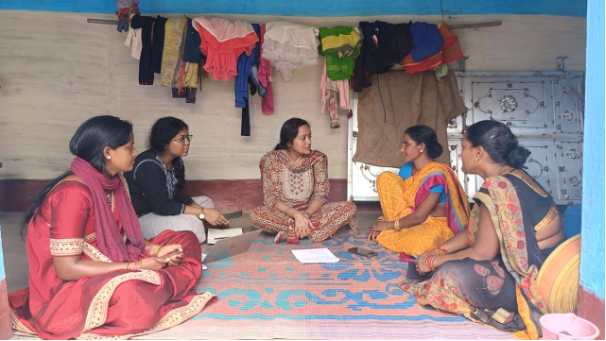
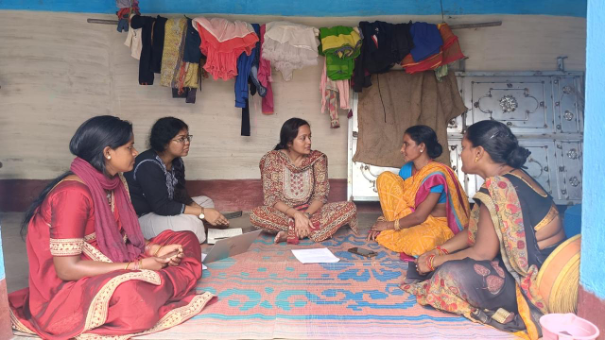
Photo: Parijat and Arpana Nandita Tirkey (from Trickle Up) interacting with the Samuday Sathis and a project participant
That is the first discipline of mentoring, and it is harder than it sounds, to stop asking “what does my program need from this person” and start asking “what does this person need from me.” The Sathis’ initial work was rarely visible. It was simply showing up, again and again, with the patience to help one family open up, start sharing their needs, and eventually begin moving towards the project goal. They demonstrated that the mentee, not the milestone of the project, came first.
“I have come to learn that a human being needs a companion more than anything else. Our widowed community members carry their pain alone. Nobody has time to listen. Through this work, they found a companion. That is what made the difference.” — Samuday Sathi, Bhaski Panchayat
A Relationship of Mutual Trust and Respect
Both trust and respect, I learned, are something one earns over time. Several Sathis spoke of learning the importance of companionship; that consistent, family-like presence was more powerful than any scheme or asset. Others described learning how to conduct fieldwork with empathy rather than instruction, “not just doing work but doing it from the heart”. They shared how initially the members from EVHH families were apprehensive, did not allow the Sathis to enter their houses, and eventually how they trusted the Sathis by being open about their vulnerabilities.
They shared that their earlier engagement with groups and SHGs had not prepared them to understand the realities of the most vulnerable households. These, in most of the cases, included widows, second wives, orphaned children, elderly people, and persons with disabilities who had little or no support. Many of these families also lacked basic documentation, such as Aadhaar and ration cards.
The Sathis did not simply process these as “cases”. What struck me during my conversations with the Sathis was that this trust ran in both directions. The Sathis did not just ask families to trust them; they listened to their concerns, respected their choices, and stayed with them through their challenges rather than treating them simply as participants to be moved through a programme. Nearly every Sathi described the relationships they built as “family-like”, and not client-like.
“Just being there, listening, following up, making sure they were not forgotten, that is what changed things.” — Samuday Sathi, Tandbalidih Panchayat
I had assumed that trust was earned through generosity, through what you could give someone. What I learned instead is that trust is earned through reliability. Through the unglamorous, unrewarded act of returning the following week, and the week after that, even when nothing seems to be changing.
Clear and Challenging Goals
The coaching/mentoring framework the Sathis were trained in has three words at its core: Aatma-vishwas (self-confidence), Aatma-samman (self-respect), and Sapna (dream). Although the baseline and midline assessments did not specifically examine changes in women’s agency, the endline survey sought to understand how the Sathis perceived these aspects by the end of the project. Around 62% of the Sathis reported seeing very significant improvement in women’s self-confidence, while almost 90% reported significant improvement in women’s say in household decisions.
However, facilitating them only to share their dream does not automatically lead to change. Initiating any livelihood intervention needed serious goal setting and planning. The Sathis not only listened to their stories or helped them articulate their aspirations and dreams, but also helped them plan how they could move towards those goals. This involved understanding the family’s assets, skills, household composition, and vulnerabilities; identifying livelihood options suited to the local context, such as backyard poultry, goat rearing, kitchen gardens, and multilayer farming; connecting them with their aspirations; and developing a structured livelihood plan that could feed into the Gram Panchayat Development Plan (GPDP).
Guiding Through Feedback and Support
Structured coaching, maintaining diaries, conducting weekly reviews, providing relevant training, and revisiting families regularly until they initiated their livelihood activities were all part of the Samuday Sathis’ daily routine. The Sathis were, in effect, running a continuous feedback loop: watching what worked, adjusting what didn’t, and being present often enough to notice the difference.
“We have to visit approximately 50 EVHH every week. During these visits, we use our weekly visit diary to keep a track of households we are visiting. We also write down discussions in this diary so that we can keep track of the actions which we have to undertake. Without constant push it is very challenging to ensure participation and action.” — Samuday Sathi, Bhaski Panchayat
Although the end goal was to link EVHH families with livelihood activities, the Sathis often had to begin much earlier, by helping families secure the basic documents required to access government welfare schemes and entitlements. This included Aadhaar cards, ration cards, birth certificates, caste certificates, and disability certificates.
Securing these documents was not a one-time task. It involved helping families navigate government offices and processes, following up on applications, and returning to the families as they worked through these requirements. Only after these barriers were addressed could the Sathis begin linking families to schemes such as Maiyan Samman Yojana, Abua Awas Yojana, Phulo Jhano Ashirwad Abhiyan, Didi Badi Yojana, MGNREGA, disability and widow pensions, and agricultural and livestock support through the Department of Agriculture, Animal Husbandry & Co-operative, Government of Jharkhand, and Krishi Vigyan Kendras.
One Sathi described what absorbing that responsibility had done to her:
“I used to get angry easily. But when I started meeting extremely vulnerable families face to face and understanding their lives, I felt deeply ashamed of myself. From that day on, I stopped getting angry about small things. Seeing the challenges they faced made me realise how different and difficult their circumstances were compared to the things I used to worry about.” — A Samuday Sathi
Feedback, it turns out, does not only flow from mentor to mentee. It reshapes the mentor too, if they are paying attention.
Nurturing Empowering Relationships
The point of any of this, ultimately, is to leave someone stronger than you found them, not dependent on you, but more capable because of you.
The story that stayed with me the most was that of Jaleswari Kumari and Mahendra Hembrom, a sister and brother from Beldih Panchayat, both visually challenged and with limited prior engagement with the administrative system. They did not have Aadhaar cards, disability certificates, pensions, or a source of income. The Samuday Sathi who identified their situation began, as she did with other families, by helping them navigate the documentation required to access these entitlements. This alone took months of persistence and follow-up with block offices, where the urgency she felt for the family was not always matched by the systems she had to navigate.
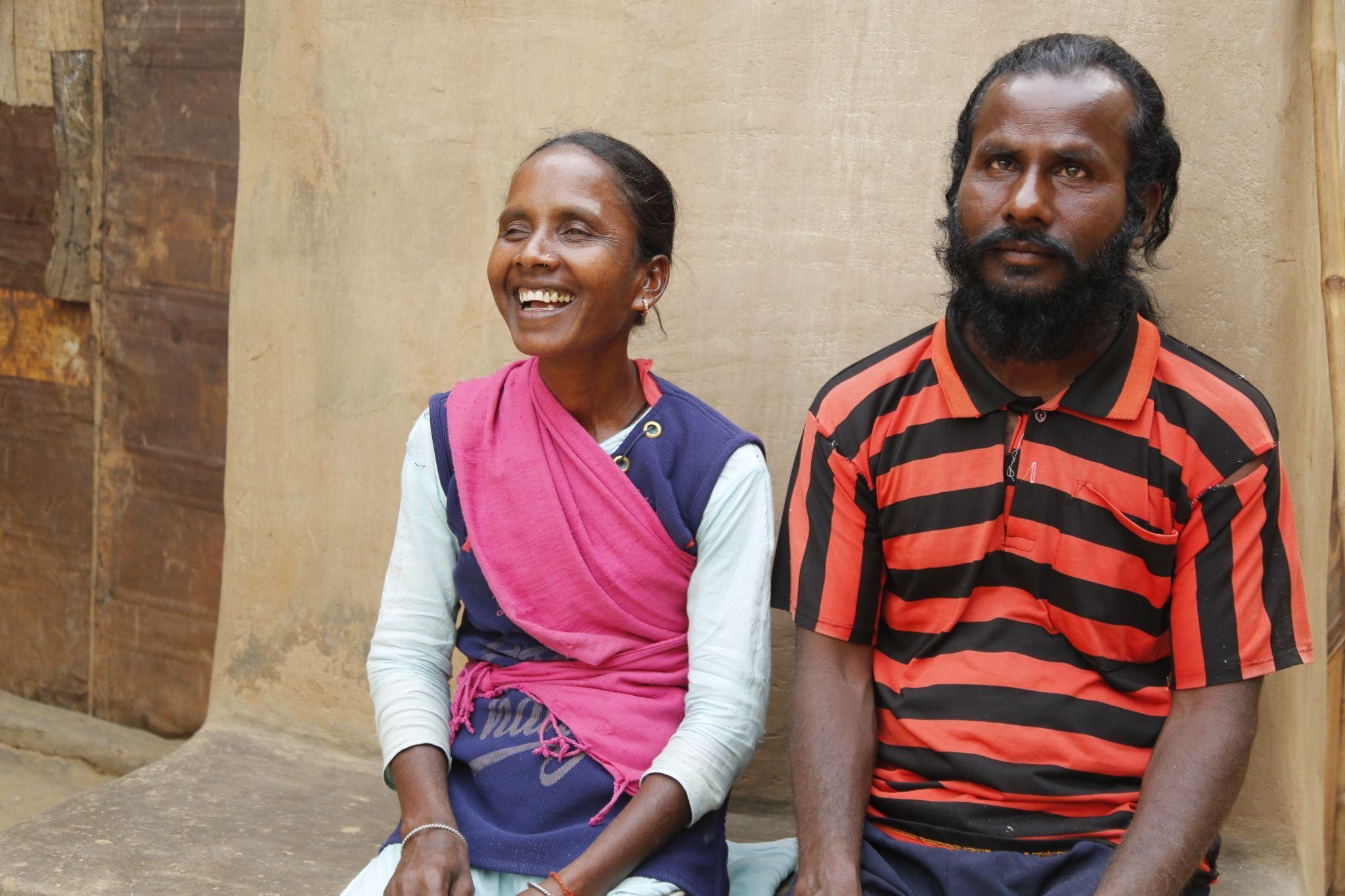
Photo: Jaleswari Kumari and Mahendra Hembrom in their home
But her role did not end with getting their documents in place. The Samuday Sathis had been part of the community for years as self-help group (SHG) members and had experience working as Community Resource Persons (CRPs). This gave them not only an understanding of local livelihoods but also the relationships and connections needed to mobilise support. The Sathi drew on this knowledge to explore whether livestock rearing could provide the siblings with a viable source of income and to identify people who could help them get started.
The Sathi admitted that she was initially apprehensive about how two visually challenged people would manage a livelihood involving livestock. Yet, rather than allowing her apprehension to determine what the siblings could or could not do, she worked with them to explore the possibilities. She connected them with people in the local livestock support system, including those with experience in poultry rearing, who could guide them on feeding, managing and caring for the birds. Her role was not to have all the answers herself, but to help the siblings access the knowledge and support they needed to begin.
Over time, the siblings developed their own ways of managing the poultry unit. They built routines around the birds’ movements and sounds. The chicks roam around the courtyard and the area surrounding their home during the day. When Jaleswari calls out to them, they recognise her voice and return. She feeds them and counts them by touch before putting them away safely. During the day, the birds are kept in a low-cost shed, while at night they are brought inside the house and covered with a large, basket-like structure. These practices, developed through familiarity and repeated experience, enable the siblings to manage the unit in ways that work for them.
Their ability to care for the birds also extends to recognising when something might be wrong. If a chick becomes unusually quiet, shows little activity or stops going out to feed, they separate it from the others to prevent the possible spread of disease. When they need further guidance, they reach out to the Pashu Sakhis for help. Rather than remaining passive recipients of support, the siblings have learnt to observe, respond and seek assistance when necessary.
The enterprise is also sustained by the relationships they have built within the village. Neighbours help when eggs are laid and assist with hatching. Local buyers and sellers remain in contact with the siblings, while people from the village also visit their home to purchase eggs. The siblings estimate the size of the eggs by touch and sell them accordingly. These everyday practices reveal how a livelihood can become manageable when people are able to draw on their own abilities, adapt processes to their circumstances and access support from those around them.
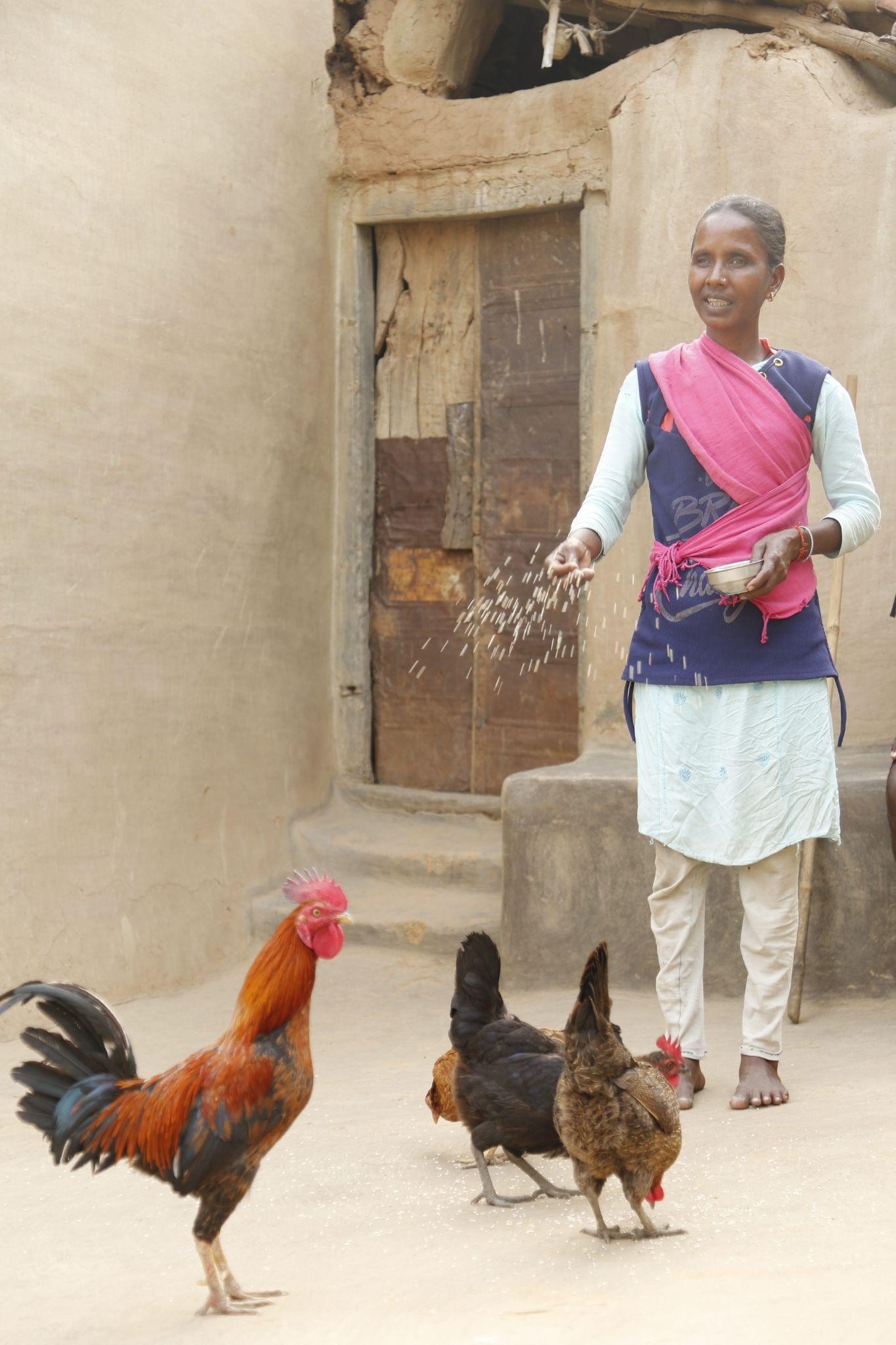
Photo: Jaleswari Kumari feeding her backyard poultry
Their livelihood activities, however, are not limited to poultry rearing. The siblings also earn money by taking their neighbours’ cows and buffaloes out to graze. Bells tied around the animals’ necks help them keep track of the animals through sound as they move around. This is another way in which they have adapted their work to their circumstances, drawing on their ability to recognise and follow sounds to undertake an income-generating activity. What might initially have appeared difficult to manage has become possible through practical adaptations and familiarity with the animals and their surroundings.
The Sathi, meanwhile, continues to visit them approximately once every fortnight. Since she lives nearby, she remains connected to the family and checks on their progress. However, her continued presence does not mean that she manages the enterprise for them. Instead, she remains available when they need guidance while allowing them to take responsibility for their work.
Over the following year, the poultry unit generated ₹10,000 in income, and the siblings learnt to manage it themselves. This amount matters, particularly for a household that previously had no source of income. But what stayed with me was not simply that they had started a livelihood. It was how they had reached that point. The Sathi had not assumed that their visual impairment made the enterprise impossible, nor had she attempted to do everything for them. She helped identify a possibility, connected them to people with the relevant knowledge and remained alongside them as they learnt to manage the enterprise in their own way.
This experience made me reflect on what it means to nurture an empowering relationship. A mentor does not necessarily need to possess all the technical knowledge required to solve a problem. Sometimes, the more important ability is to recognise what might be possible, identify the right people and resources, and create the conditions in which someone else can learn and act. The Sathi’s knowledge of the community helped her identify a livelihood opportunity; her relationships enabled her to mobilise specialised support; and her continued engagement gave the siblings the space and confidence to develop their own practices.
There was also a shift in how I understood the relationship between support and independence. The siblings did not have to manage every challenge alone, nor did becoming independent mean that they would never need help again. They learnt to manage their enterprise, recognise problems and reach out to the appropriate people when necessary. Their growing independence lay not in the absence of support, but in their ability to make decisions, take actions and draw on available resources themselves.
That, to me, is what an empowering relationship looks like at its endpoint: the mentor’s presence becomes less necessary, not because she has walked away, but because she has helped build the confidence, capabilities and connections that allow others to move forward. The goal was never to create a permanent client relationship or make the family dependent on her. It was to help them find a way to sustain themselves, with the agency to shape their own future.
It also made me wonder: when does a mentor know that it is time to step back? Perhaps an effective exit is not a withdrawal from a relationship, but the point at which the person being supported has enough confidence, connections and capability to move forward without the mentor’s continued intervention. The relationship need not disappear; its nature simply changes. The mentor remains a companion who can be approached when needed, while the person once being guided becomes increasingly capable of finding their own way.
What I take with me
It made me ask myself a harder question: how much of what we call “development” begins with something as simple as one person being reliably present in another person’s life for long enough for them to believe that things can change? We build frameworks, logframes, and theories of change to explain how transformation happens. Yet, in this project, much of that change seemed to begin with something far more ordinary, a woman walking thirty or forty minutes, often on foot, to sit with another woman, listen to her, and ask how she was doing.
My role in this process was to understand and document the effectiveness of the project. But spending time with the Samuday Sathis left me with a more personal understanding of what mentoring demands. It requires putting another person’s needs at the centre, earning trust over time, helping them set goals that they can work towards, staying alongside them through setbacks, and offering the support they need without taking away their agency. Perhaps most importantly, it requires recognising that success does not lie in making someone dependent on you, but in helping them become more confident and capable of moving forward on their own.
This is what the Samuday Sathis taught me about mentoring. The five principles I had understood as ideas in the abstract; putting the mentee first, building mutual trust and respect, setting meaningful goals, guiding through feedback and support, and nurturing an empowering relationship became tangible in the way these women worked every day. They showed me that mentoring is not simply about having the right answers or expertise. It is about the patience to listen, the consistency to stay alongside someone, and the humility to eventually step back when the person you have been supporting no longer needs you to lead the way.
About the Author