
Between Beliefs and Diagnosis: Understanding Witch-Hunting in Jharkhand.
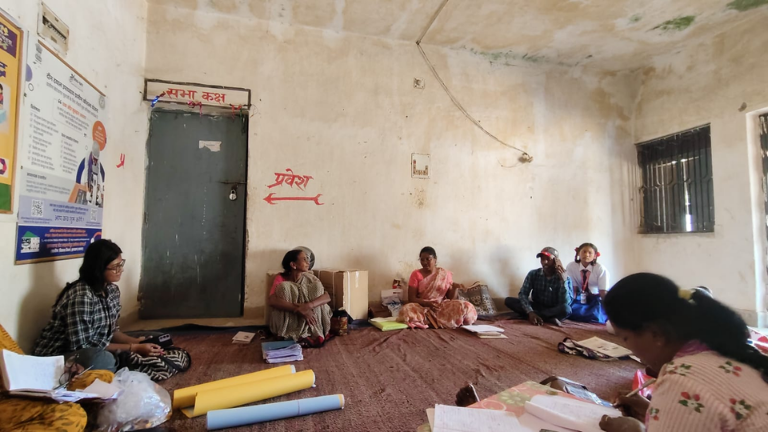
-Swastika Mohapatra, Executive, PRADAN
This article explores the practice of witch-hunting in Jharkhand and its intersections with belief, gender, health and social vulnerability.. Drawing from personal observations and wider research, the article reflects on how deeply rooted beliefs can shape perceptions, relationships and social exclusion, and the human cost of giving a person a label instead of an explanation.
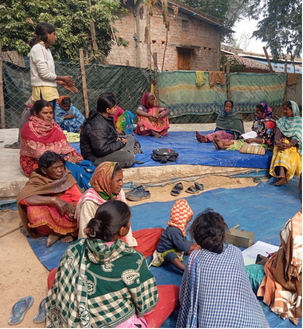
Photo: Interaction with women in the SHG
Sitting with community members, especially women, and listening to them share old tales; stories much like the ones I grew up hearing from my grandparents was one of the best parts of my village stay when I joined PRADAN as a Development Apprentice in Torpa, Jharkhand in August 2025. In those moments, I felt a little closer to home.
I was living in the village of Jagu where I observed, understood, and got to know the lives of the local communities more closely. I would visit the women at their homes, help with their daily chores, and often sit and listen to them for hours. Stories of accidental deaths, sudden illness of livestock or family members and other unexplained events were also a part of everyday conversations.
Many of their stories reminded me of those my grandparents told us during summer vacations and family gatherings; stories of tantras, ghosts, witches, and things that seemed frightening when we were children but became amusing as we grew older. I would listen to these stories with curiosity, sometimes laugh them off, and never really think much about whether there was any truth behind them.
That changed about a month after my village stay. I came across an article titled, “Jharkhand reports highest witch-hunting and honour killings in India: 2023 NCRB data reveals alarming stats.”
The headline made me pause.
What I had until then understood as stories, something familiar from my own childhood was, for some women in these communities, connected to a much harsher reality.
The more I dig deeper
The article left me unsettled. I found myself wanting to understand the what, why, and how behind witch-hunting, why does a belief so old continue to have the power to shape people’s lives, and sometimes even end them?
The numbers also made it harder to look away. According to 2023 data from the National Crime Records Bureau (NCRB), Jharkhand recorded 22 witch-hunting-related murders, the highest among Indian states and twice the number reported in 2022. And yet, there was a small glimmer of relief when I came across a more recent report. The Times of India, citing NCRB data, reported that Jharkhand recorded five witch-hunting cases in 2024, compared to 22 in 2023. I paused at those numbers. Five is certainly fewer than 22. But five is not zero. And behind each number is a person, a family, a community, and a belief that can turn violent.
The more I read, the more I realised that witch-hunting is neither uniquely Indian nor confined to one region. The idea of the ‘witch’ has travelled across geographies and centuries, with the Salem witch trials of the 1690s remaining one of the most enduring examples of how fear and social tensions can transform ordinary people into perceived witches.
But what makes societies turn to witch-hunting to explain misfortune in the first place?
Looking further back into European history, I came across accounts of how urbanisation, epidemics, economic changes and the Little Ice Age unsettled existing social and religious hierarchies. Sociologist Yehuda Ben-Yehuda argues that in such periods of profound change, communities may seek to restore a sense of order by identifying and punishing those perceived as threatening existing moral boundaries.
Perhaps that is one reason the idea of the witch has proved so enduring. When something frightening happens, an illness, a death, a crop failure, an unexpected loss, we look for an explanation. And where scientific knowledge, healthcare or other forms of certainty are limited, supernatural explanations can become easier to accept.
Beliefs around witchcraft and witch-hunting have been documented across the world, and the consequences of witch-hunting can be devastating to the victims, in which women are often disproportionately targeted.
In India, the accusation can also become entangled with questions of gender, property and power. Women, particularly older women and widows have been accused of witchcraft and driven out of their homes. In some cases, such accusations can also create an opportunity for others to appropriate their land or property. What appears on the surface to be a story about superstition, then, may conceal deeper struggles over resources, social standing and control.
The more I dug, the less this seemed like a story about an irrational belief alone. It began to look like a story about fear, uncertainty, power and the ways in which societies decide who belongs and who can be made an outsider.
In Jharkhand
To understand witch-hunting in Jharkhand, I felt I first needed to understand the place itself. Jharkhand is a cultural mosaic shaped by generations of communities that have inhabited the region for centuries. Home to 32 tribal communities, the state carries a rich heritage expressed through its traditions, rituals, folk art, music and social institutions. Much of this culture remains closely connected to the forests and land that shape people's lives and livelihoods.
It is this richness that makes the persistence of witch-hunting in the state particularly unsettling. In several tribal-dominated regions, beliefs around spirits, supernatural forces and traditional healing coexist with poverty, limited access to healthcare, and social marginalisation. Within this context, women can become particularly vulnerable to accusations of witchcraft.
Once branded a witch, a woman can face public humiliation, social exclusion, physical violence and, in the most extreme cases, death. What makes the violence even more difficult to confront is that it can occur with the participation or acceptance of sections of the community. Fear of retaliation, social stigma and pressure from within the community can also prevent survivors and their families from reporting these incidents.
Jharkhand enacted the Prevention of Witch (Daain) Practices Act, 2001, making witch-branding and related practices punishable offences. Yet legislation alone cannot address a belief system that is deeply embedded in social and cultural contexts. Uneven implementation, limited access to justice and underreporting continue to make the problem difficult to confront. Addressing it requires not only stronger enforcement, but also sustained work around education, gender awareness, access to healthcare, and community-led efforts to question the beliefs and power structures that allow such violence to persist.
As I continued reading, however, I discovered that the history of witch-hunting in Jharkhand was more complicated than I had initially imagined.
In his work 1857: Witch Hunts, Adivasis and Uprising in Chhotanagpur, historian Shashank Sinha draws attention to a lesser-known aspect of the region's history. He explores how beliefs around witches, spirits and ojhas, traditional healers and spiritual practitioners were deeply embedded in Adivasi social life, and how these beliefs became entangled with the colonial encounter.
Sinha argues that colonial attempts to regulate witchcraft and traditional healing were also seen as an attempt to regulate indigenous belief systems. In the years leading up to the 1857 uprising, the continued practice of these traditions, despite colonial restrictions, could at times function as an assertion of community autonomy and resistance to colonial interference.
This history left me with uncomfortable questions. When does a belief become a source of identity? When does it become a tool of power? And when does it become violence?
Perhaps in Jharkhand, the answer is not as simple as choosing one over the other.
Some Personal Experiences
As I kept reading about witch-hunting, I found myself thinking about certain situations I had witnessed during my stay in Jagu. They were not always instances of physical violence. Sometimes, the violence was subtle, embedded in the words used to describe someone, in the way a person was treated, or in the gradual withdrawal of a community.
One such person was Jitiya Kumari (name changed), whom I met during my village stay. She had once been an active member of an SHG. Around four to five years ago, she underwent brain surgery, which was reportedly unsuccessful. Following the procedure, her mental and cognitive functioning changed significantly.
Instead of receiving empathy and support, she was gradually labelled “mad” by some and “possessed” by others. Over time, these labels began to shape the way the community interacted with her. The woman who had once been an active member of the SHG gradually became socially isolated, with most people in the village no longer interacting with her as they had before.
I found myself thinking about her again when I attended an SHG meeting in a hamlet in Ukrimari Panchayat that I had never visited before.
It was a sunny afternoon. I parked my two-wheeler and noticed a young girl whom I assumed to be around 17. I greeted her with a polite, “Johar.”
She looked at me but did not respond.
I wondered if she had not heard me, so I repeated myself. Then a third time. And a fourth.
By then, I felt a little uncomfortable under her constant, indifferent stare. I could have easily interpreted it as rudeness or hostility. Instead, I decided not to assume anything and walked towards the nearest house.
A loud thud at the gate brought a community member outside. I pretended as though nothing had happened. She asked me to sit down, offered me some water and then asked, “Kya hua didi? Usne kuch kiya toh nahin?” (What happened? She didn't do anything, did she?)
“Didi, unko kya hua hai? Woh theek toh hain na?” (what happened to her? She's okay, isn't she?) I asked.
She did not answer. Instead, she asked my name and where I lived. Before I could finish, she called out to a few other women community members from the neighbourhood.
After a while, I asked again about the girl I had seen outside. The women looked at one another and exchanged a knowing smile.
Then Seema Kumari (name changed) leaned towards me and quietly said, “Didi, kisiko bataiyega nahi. Yeh achanak se ek din school se aa rahi thi aur behosh ho gayi. Jab hosh aaya, tab kuch samajh nahi paa rahi thi. Dheere-dheere aisi ho gayi. Isko gaon mein daain bolte hain.” (please don't tell anyone. One day, she was suddenly coming home from school when she fainted. When she regained consciousness, she couldn't understand anything. Gradually, she became like this. In the village, they call her a witch)
They called her a daain.
I remember sitting there for a moment, trying to process what I had just heard.
A girl who had perhaps been on her way home from school one ordinary day had fainted. Something had happened to her, something that had altered the way she behaved and interacted with people. And somewhere along the way, the explanation had shifted; from something happened to her to something is wrong with her.
Looking For Answers
I returned from the village with nothing but Seema Kumari’s last words stuck in my head: “Isko gaon mein daain bolte hain.” (In the village, they call her a witch)
During my ‘learning by doing’ phase of the Development Apprenticeship, I was working on the Gender Integration theme. I had already heard about the Gender Justice Centre (GJC) and the cases it had counselled; witch-hunting, sexual exploitation, domestic violence, and other forms of gender-based violence. So, when I returned to Torpa, the GJC was where I went first.
Established under the Deendayal Antyodaya Yojana–National Rural Livelihoods Mission (DAY-NRLM), the Gender Justice Centre is a block-level community institution working on gender equality, social justice and women's empowerment. It supports SHGs, VOs and CLFs in addressing gender-related issues and facilitates access to legal, medical, psychological and rehabilitation services.
Photo: Interaction with women at GJC
I went there hoping that, if not all, I might at least find some answers.
I spoke with the Gender Resource Persons about the witch-hunting cases they had encountered and counselled over the years. We discussed what leads a woman to be called a daain, how her family responds to the accusation, and what happens to her place within the community once the label takes hold. I also spoke with women at the CLFs to understand whether they had heard of, witnessed, or encountered similar incidents, cases that, despite years of awareness and intervention, continue to occur.
What I heard made me think again about the girl in Panchayat- Ukrimari.
The Gender Resource Persons told me that, in several cases they had encountered, when a woman begins behaving differently that is, screaming, shivering, fainting, becoming unusually withdrawn, or even remaining silent for days; the first question asked in the community is often not “What happened to her?” but “What has she done?”, implying that her behaviour must be a consequence of some wrongdoing on her part.
The search for an explanation can quickly turn into an accusation.
A woman may be labelled a daain, after which she can be ostracised, humiliated, or treated with suspicion. In some cases, the consequences are far more violent, even fatal.
I was told that the practice has reduced significantly over the years, but it has not disappeared. Perhaps it has become less visible rather than ceased to exist altogether. And in the absence of adequate awareness about mental and physical health, an unfamiliar change in a person's behaviour can still be explained through superstition.
When Symptoms Become Superstition
I searched further into the behaviours I had witnessed and heard about, I began to wonder how many experiences labelled as ‘witch possession’ might have medical or psychological explanations?
The National Mental Health Survey conducted by NIMHANS found that the treatment gap for mental disorders in India remains extremely high, ranging from 70% to 92% across different disorders. NIMHANS' assessment of mental health systems also highlights the uneven distribution and inadequacy of mental health facilities, particularly affecting access in rural and remote areas.
I began to think about this in the context of Torpa.
According to the 2011 Census, 84,399 of Torpa's 92,991 residents lived in rural areas. Healthcare facilities in the block are limited, and specialised mental health services are even harder to access. When I searched for a facility that could provide treatment for mental health conditions, I found that the nearest specialised institute was in Ranchi, roughly 70 kilometres away.
Seventy kilometres may not sound like an impossible distance. But for a rural household, seeking treatment can mean deciding who will accompany the person, who will stay back, how the journey will be paid for, and whether the family can afford treatment.
I found myself going around in circles with questions.
Is mental healthcare even accessible here? Is it discussed? How far is it practically possible for someone to travel for specialised care? If they do make the journey, can they afford the treatment? Has anyone told them that the changes they are experiencing may have a medical explanation, and that they can seek help? When there is no doctor to provide an explanation, does the community create one for itself?
I began to understand how the absence of medical knowledge and access to care can leave a vacuum, and how that vacuum can be filled by familiar cultural explanations. When a person experiences a seizure, loses consciousness, becomes withdrawn, behaves unpredictably, or experiences changes in memory or perception, a community without access to adequate health information may interpret these experiences through the lens it already knows.
For instance, Epilepsy can involve seizures and temporary loss of consciousness, while dissociative disorders can affect memory, identity or awareness. Other mental health conditions can also alter perception, behaviour and everyday functioning. Only a qualified health professional can diagnose these conditions. But without such understanding or access to care, behaviours associated with illness may be interpreted as evidence of something supernatural.
This is where the gap between cultural interpretation and medical understanding becomes consequential.
The answer, perhaps, is not to dismiss people's beliefs or ridicule the explanations they have grown up with. It is to create another explanation, one that makes room for illness, treatment, empathy, and recovery. Because when a health condition is mistaken for possession, the person may not receive the care they need. And when that person is instead branded a daain, the consequences can go far beyond a missed diagnosis.
That can mean losing one's family, one's community, one's home, and sometimes, one's life.
The Questions I Carried Home
The stories I had heard, combined with my conversations at the GJC, began to reveal a pattern. Those labelled as daain were often women who were already vulnerable in some way, widowed, elderly, socially isolated, economically dependent, or without anyone who could advocate for them. In some cases, the person was a young girl whose behaviour had suddenly changed.
But I kept returning to one question: was it underserved communities that were more vulnerable to such beliefs, or were women within these communities particularly vulnerable to being labelled and punished?
I carried this question with me. In the villages I continued to engage with, I spoke to more community members, hoping that someone might help me make sense of it. Yet whenever I brought up daain or possession, the conversations would become guarded. Some would change the subject; others would simply avoid answering. It was as if the subject itself was something nobody wanted to touch.
I still wonder about that little girl I met by accident.
Does she know that some people in her village consider her a daain? Does she know that the behaviour she has no control over has been given a name, and that the name carries so much fear?
Torpa, with its deeply rooted culture and forests of ethereal beauty, is a place that will stay with me, wherever I go. But so will the image of that girl, and perhaps the countless others I never met standing at the edge of a world they may not fully understand, simply wanting to be heard.
About the Author