

Walking Beside Her: Kumudei’s Journey of Courage and Change
-Rashmita Sethy, Team-Coordinator, PRADAN
Some people step into your life without much noise, yet they rearrange something inside you so profoundly that their presence stays long after they leave. For me, that person is Kumudei.
Even her name carries a kind of defiance; Kumudei.
Kumudei means “water lily”, a flower that rises unbothered through murky waters to bloom in its own quiet splendour.
A name that talks about a woman who refuses to sink, who insists on living fully even when life offers little more than scarcity and struggle. Perhaps that was what struck me the very first moment I saw her: an unspoken boldness, a fire.
A little bit about me!
Hi, my name is Rashmita Sethy. I stepped into the world of the development sector via PRADAN in August 2017, unaware at the time of how deeply the journey would shape who I am today. I began as a Development Apprentice (DA) and was placed in Lamtaput, an interior block around 45 kms from the Koraput district headquarters in Odisha, predominantly inhabited by tribal communities.
In 2018, I transitioned into the role of an Executive and took on the anchorship of the livestock theme. However, my engagement with livestock had already begun during the DAship phase itself. I was naturally drawn to the vertical, sensing its potential as an underutilised resource with significant opportunities for income generation in the region.
My work focused on enhancing the incomes of rural families by promoting improved livestock-rearing practices. This included ensuring the systematic completion of vaccination cycles, improving shed construction, and introducing better breeding and management practices for small ruminants such as goats and backyard poultry (BYP).
At the time, the livestock situation in the villages was alarming, with mortality rates of nearly 65% among goats and poultry. Although vaccines were available, limited awareness among around 70% of goat rearers about improved rearing methods and disease-management practices rendered these measures ineffective, resulting in stagnating goat populations. Farmers largely depended on market intermediaries to sell their livestock, often receiving inconsistent and un-favourable prices. In the case of poultry, the introduction of improved breeds was an urgent need. Traditionally, farmers reared only desi birds, which were sold mainly during household emergencies or festivals. Although training programmes promoted rearing birds for both eggs and meat, desi breeds remained less remunerative, taking nearly eight months to reach just one kilogram in body weight.
Vaccination services reached only a handful of households, and in the absence of mass vaccination drives, disease outbreaks frequently resulted in large-scale losses. However, villages where initial trainings were conducted showed visible improvements within two to three weeks, clearly demonstrating the impact of timely capacity-building. These experiences underscored the need for trained personnel at the block level to support Livestock Instructors and ensure continuity of the initiative.
By August 2020, still working in the same block, we began scaling up livestock as a dependable livelihood option. This required committed Master Trainers (MTs)—remunerated community resource persons responsible for supporting families throughout the livestock-rearing cycle. As the team lead for the livestock theme, I actively sought individuals who could grow into strong MTs and join us in making livestock rearing simpler, more accessible, and more reliable for tribal farmers.
The Day I met Her!
It was August 2020. I was at the PRADAN office, conducting interviews to select Master Trainers (MTs) for our livestock programme. The pandemic had unsettled everyday life. Agriculture was struggling, production had dipped, and people had stopped visiting one another’s fields for activities like transplanting. Amid this uncertainty, our team chose to strengthen livestock-based livelihoods, something families could manage from their homes with minimal dependence on external labour.
During the COVID-19 period, movement was permitted only in a limited manner, and social organisations could operate only after receiving permission from the Block Development Officer (BDO). In this context, the role of MTs was designed differently. They were largely confined to their own villages or one or two nearby villages, rather than moving extensively across the block. In Lamtaput, backyard poultry (BYP) rearers were also concentrated in specific pockets instead of being widely dispersed.
Given these constraints, our focus was not on expansion, but on awareness-building and strengthening the vaccination system in areas where livestock populations were relatively higher. By prioritising selected Gram Panchayats and working within restricted geographies, MTs were able to support households without violating social-distancing norms. This approach made the intervention both practical and effective, even during a period of limited mobility.
We needed someone who could mobilize women, work closely with communities, and help shape the livestock work in the block.
The morning of the day for interviews was a blur of faces. One after another, candidates walked in — some confident, others hesitant, most carrying the nervousness that comes when hope is fragile. And then she walked in: a young girl, barely 23, simple, shy, her whole body trembling.
When it was her turn, she walked in quietly, her eyes downcast, fingers nervously clutching the end of her dupatta.
I started the way I usually do:
“How are you? And why do you want to work as a Master Trainer?”
What happened next took me by surprise. She suddenly broke into tears, unable to hold them back. I paused, wondering if my question had unsettled her. It was such a routine question, why had it made her cry?
Through her tears, she managed to whisper:
“Mun Kumudei Khada, mor block Lamtaput, Koraput jilla ra. Didi, Kete dina heijaithiba, mote gote loka missa pacharinathibe ki mun kemti achi, kan sabu chalichi. Kehi kebe setiki sarda re v pachari nahanti didi.” (I am Kumudei Khada from Lamtaput block in Koraput district. Didi… it’s been ages since anyone asked me how I am, how my life is going. No one ever cared to ask.)
Those words stayed with me. It wasn’t just nervousness; it was the loneliness and weariness of someone who had gone without acknowledgment for years.
She then added, almost pleading:
“I really want to do something. I can’t just stay at home like this. Whatever the work is, I will give it my whole heart and passion.”
That was the moment. I could sense both desperation and determination in her voice. She was fragile, yet fiercely eager. I decided not to let this chance slip away.
“Alright,” I said gently, “let’s try this for seven days. You’ll be in the observation stage. We’ll see how you’re working, and then decide about confirmation.”
She nodded, wiping her tears. Neither of us knew then that those seven days would mark the beginning of an experience; not just for her, but for me as well.
A little bit about Kumudei Khada.
Kumudei has two elder sisters and one younger sister. By the time her father decided to marry another woman simply because he wanted a son, one of the elder sisters had already married and moved far away. The other, unable to bear the sudden chaos and humiliation, left with a boy. Overnight, the family fractured, leaving only Kumudei, her mother, and the youngest sister to hold themselves together.
Photo: Kumudei with her family
She had completed her graduation in Arts from Jeypore Women’s College, a milestone that should have opened doors. Instead, life pushed her in the opposite direction. Even after graduating, she worked long hours as a labourer, bending over other people’s fields, taking up whatever work she could find just to earn a little. The tension in the village after her father’s second marriage made it unsafe and nearly impossible for her to travel elsewhere in search of better opportunities. So she stayed back, choosing survival over dreams, doing the kind of physically demanding work that leaves its mark on both body and spirit.
During those difficult years, she would often watch a few boys in the village doing mobilisation work and earning a steady monthly income, while she struggled from day to day. Around that time, Narayan, a friend of hers who lived near her home and someone she often spoke with about job opportunities, told her about possible working opportunities as a community mobiliser. When he came to know about the role, he immediately reached out to her.
She wanted to try, but fear held her back. Her father would come home drunk, his anger often spilling onto her mother. The thought of telling him about a job, about stepping out of the house felt dangerous.
So, she didn’t tell him. She gathered whatever courage she had and went for the interview, without a word at home. Even after she got selected, she kept the job a secret from her father for nearly three to four months, working each day with the weight of that hidden truth, yet holding on to the one thing she had finally found: a chance.
The days forward
I explained to her that we would initially focus on the marketing and community-mobilisation aspects of an MT’s role, since she couldn’t begin discussing the technical details of livestock right away. But by visiting villages with me, she could start learning the mobilisation and marketing components immediately.
The very next day, post her interview, we set out for the villages. As we travelled, she confessed,
“I am very nervous. I have never conducted meetings before, never spoken in a public setup. I don’t know how I will do this.”
I reassured her, “It’s alright. Just observe me today. See how I conduct the meeting. In the next village, you can try.”
She agreed. Silently. Unsure of what is to come next.
That day, I was conducting a training session on deworming and vaccination of small ruminants in Kangarapada village of Lamtaput Panchayat, with around 35 people gathered. I noticed her sitting quietly in a corner, notebook open, pen moving quickly. She wrote down everything; each instruction, each gesture, every sequence of steps. Watching her focus, I felt a small sense of relief. She was observing, absorbing, trying.
When we moved to the next village, Kadam, I encouraged her to take the lead. She gathered the people with clear hesitation on her face, stood before them, and began speaking. Her voice was barely audible. The sentences came out fragmented, her eyes fixed on the ground. After a few minutes, she stepped aside, unable to continue, and let me take over.
Later, I came to understand the reason behind her discomfort. In those early days, she carried nervousness, not because she lacked knowledge of the subject matter, but because she feared the villagers wouldn’t take her seriously. Many of them knew she was “Ghenua Khada’s daughter,” and the judgment attached to her father made her shrink. She carried an invisible burden of guilt and shame that held her back from even introducing herself properly.
During the ride back, she stayed silent, lost in her thoughts. I kept asking, “How do you feel? What do you think?” but she didn’t respond. I wondered if perhaps I had expected too much. That evening, I sent her a message about the next day’s schedule. No reply. “Maybe she just needs rest”, I thought.
What I didn’t know was that, at the same time, she was sitting with her mother and younger sister, finally letting everything spill out; her fear of speaking, the shame of being known as “Ghenua Khada’s daughter,” the worry that villagers wouldn’t listen because of what they thought about her father. Her mother, who was listening quietly, said, “Start from a village where no one knows you. At least try. If you find it difficult, you may come back.”
The next morning, around 8:30, I tried calling her. No answer. A small uneasiness crept in, but I decided to head to the village anyway.
What I saw there left me stunned.
There she was, standing before a large gathering, notebook in hand, explaining the steps of the training. Her voice still trembled, but she kept going, pushing herself word by word. And the people were listening. The community members came up to me and said, “We understood everything, didi. We will start now.”
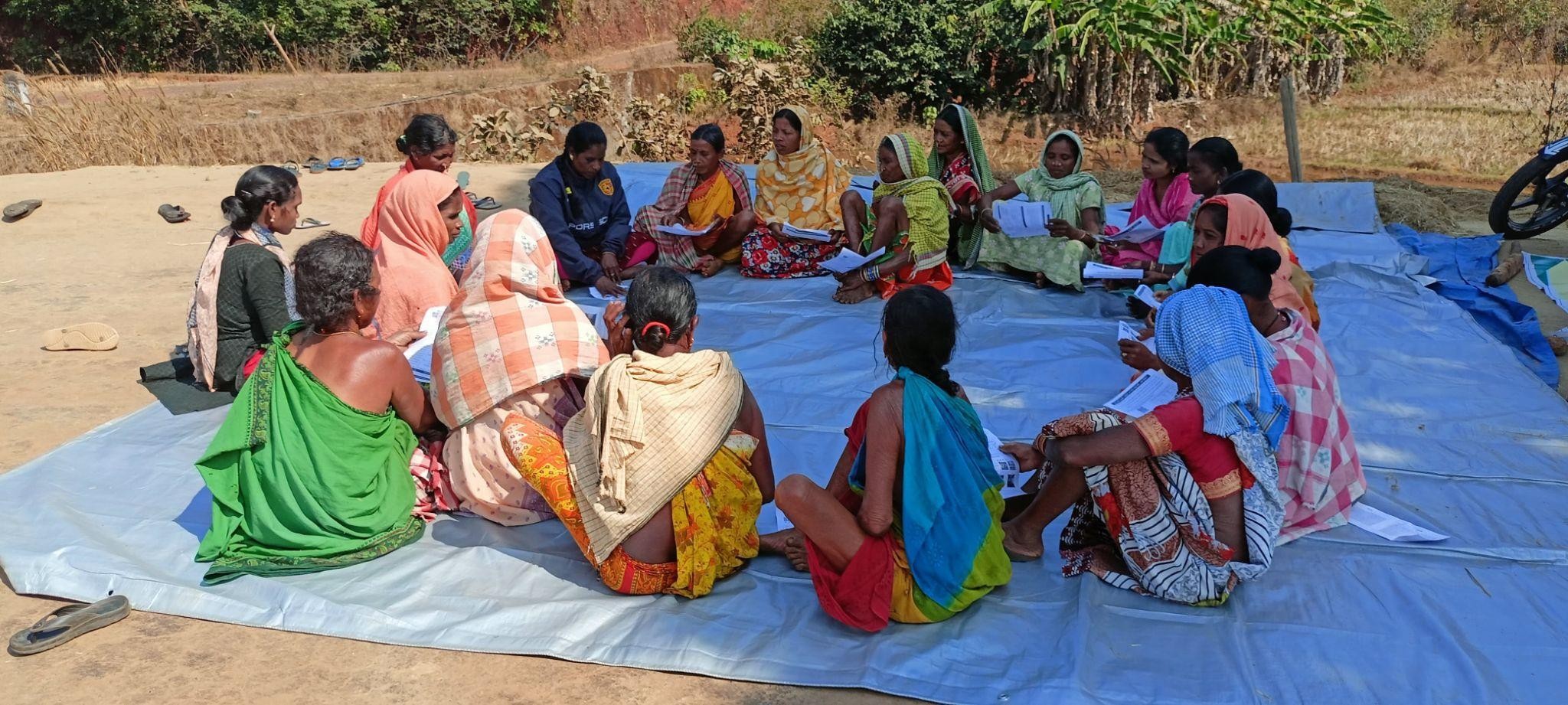
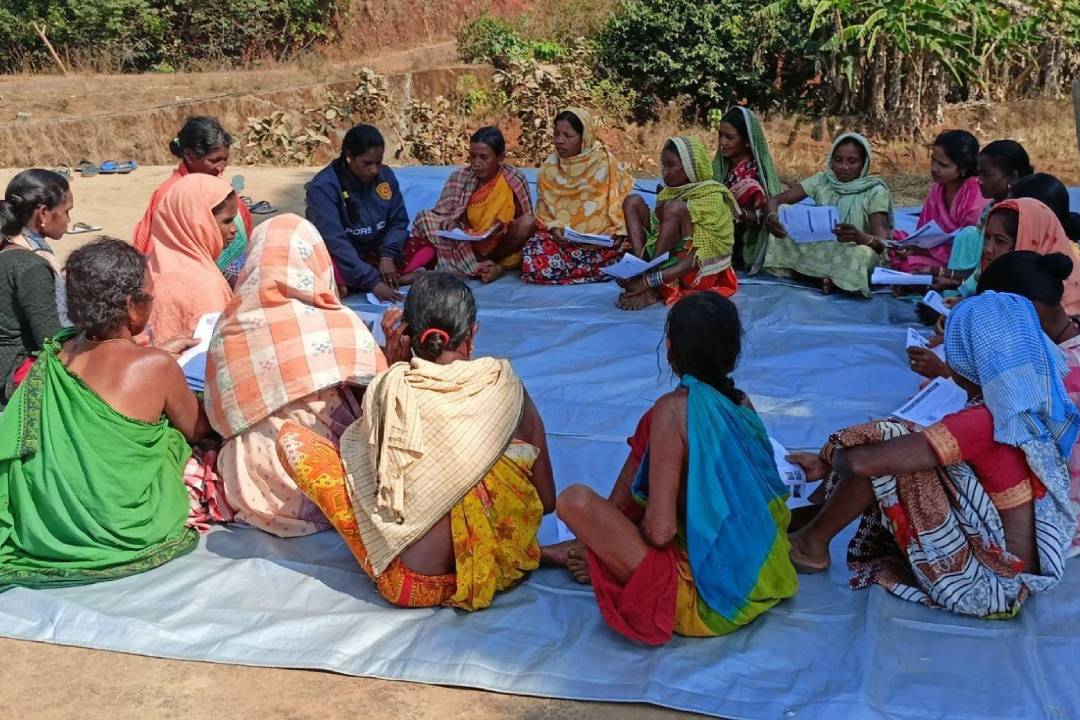
Photo: Kumudei conducting training program with livestock rearers
On our way back, I glanced at her. For the first time, she had a small smile on her face.
“Kemtii rahila aji?” (How was it?) I asked.
She looked ahead and said simply, “Mun ebe poora kariparibi didi.” (I can now do it entirely.)
That was all I needed to hear.
Onward and Upward
Within just three to four days, Kumudei threw herself wholeheartedly into learning the essentials of livestock management. She received training on creating awareness around livestock rearing and explaining the benefits of backyard poultry (BYP) and goat rearing as supplementary income sources. Since her mother had also been a livestock rearer, Kumudei had grown up witnessing the financial value of keeping animals, especially poultry. That familiarity helped her grasp the concepts, even if putting them into words for others still felt intimidating.
In the initial days, she conducted training on livestock rearing, timely vaccination, and improved shed practices. She often paused mid-sentence, searching for the right words, her voice dropping whenever too many people gathered around. Yet, her understanding of the work was strong, and slowly, she learned how to lean on that strength to overcome her nervousness.
As part of the standard seven-day plan for new Master Trainers, she underwent both classroom sessions and field demonstrations. For Kumudei, we arranged two classroom training sessions followed by two field visits, giving her a steady mix of theory and practice. During the field demonstrations, she sometimes hesitated to step forward, waiting for someone else to begin. But each time she managed to explain even a small concept correctly, her confidence grew just a little more.
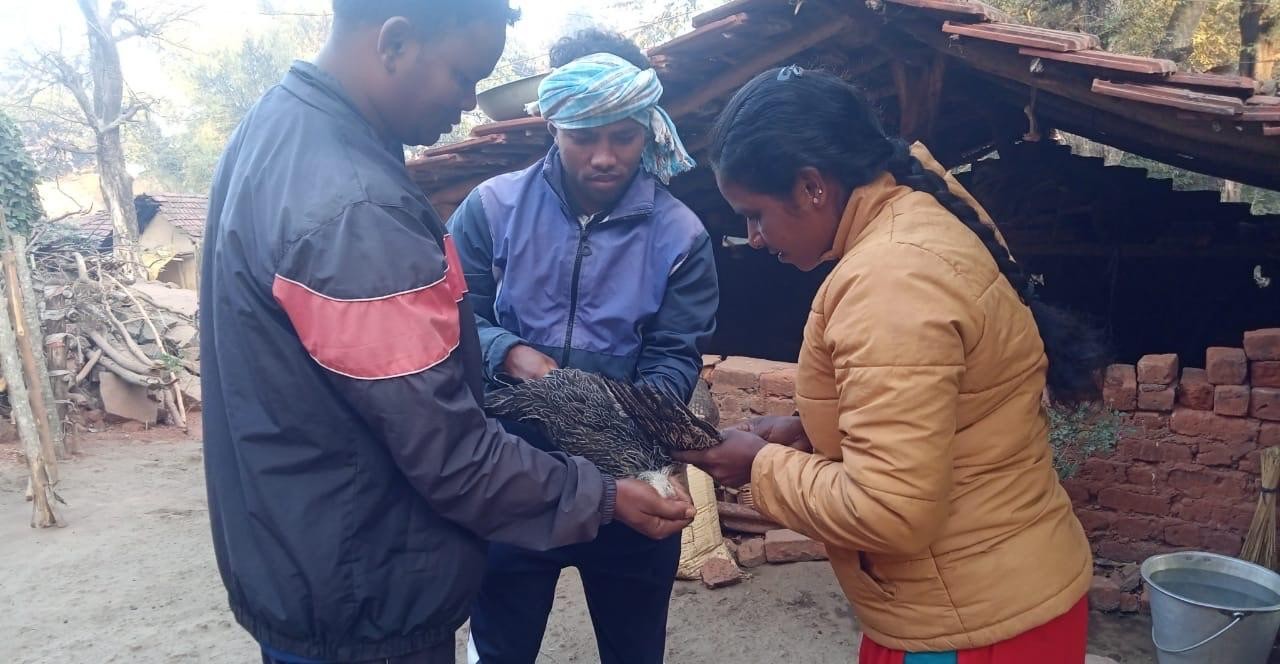
Photo: Kumudei providing vaccination service
By the end of the week, she had begun reaching out to multiple villages across the Lamtaput panchayat. Not effortlessly, not without fear but with determination. The villagers noticed her sincerity. They were curious, patient, and gradually began approaching me with requests for shed construction, for BYP units and for goat rearing support.
My heart swelled with pride. This was the same girl who had stood before me just days ago, nervous and overwhelmed at the thought of addressing a crowd. She was still learning, still stumbling over words sometimes, but she was trying—trying with all her heart. And that, more than anything else, showed me the potential she carried as well as taught me that consistency and hard work can take you places.
Her Experience as a Master Trainer
Seeing her dedication and perseverance, it was time to confirm her as a Master Trainer (MT). She began with a modest remuneration of just ₹3,000 per month, but the value of her contribution far exceeded the amount. Once she stepped into the role, she committed herself fully; carefully collecting vaccination data, learning to administer vaccines correctly, memorising vaccination cycles, and consistently motivating women rearers to adopt improved livestock practices.
Over time, she also began visiting villages where people knew her father. Despite her initial fear of being recognised, she gradually realised that familiarity worked in her favour. Those who had known her earlier and were aware of her journey listened more attentively during training sessions. Some even welcomed her into their homes and offered her food, challenging many of the assumptions she had carried with her.
A few villagers continued to ask personal questions, often in a sympathetic tone; about her father’s behaviour or how her mother was coping. Kumudei responded calmly, saying her mother was doing well and that her father no longer lived with them, so she could not speak for his decisions. Over time, she chose to remain focused on her role and the purpose of her work, prioritising what she had come to deliver rather than engaging with deeply personal inquiries.
It was not easy. Some days, she returned home exhausted, her feet aching from walking long distances. On others, she struggled to explain things patiently when villagers were sceptical or uninterested. But she kept showing up. Day after day, she walked from one hamlet to another, meeting community members, answering questions, and ensuring that information on livestock rearing reached every corner of her panchayat.
Around this time, the concept of Model Village was introduced. A Model Village was envisioned as one where all thematic interventions—agriculture, livestock, plantation, and irrigation were comprehensively implemented. Within the selected villages, focused engagement with livestock rearers ensured end-to-end support, including vaccination, improved housing, and market linkages, along with the introduction of dual-purpose birds and coordination with relevant departments when required. Such villages were intensively saturated with thematic interventions, with greater focus given to those having a higher concentration of livestock rearers. Under this approach, the role of the MT expanded to providing comprehensive livestock support across the entire value chain, from awareness-building and shed development to rearing practices, vaccination, and market linkages. The objective was to move beyond fragmented interventions and ensure end-to-end support for livestock rearers.
Kumudei identified five villages to be developed as model villages, one of which was Khadaput in Tusuba Panchayat. Located in an interior area, the village had collectively decided not to rear goats. However, after initial discussions, the community showed openness toward backyard poultry (BYP) as an alternative. When Kumudei began working there, only one farmer owned poultry, and even she had not achieved stable income, as livestock was not yet seen as a viable livelihood.
Mobilising the entire village was challenging. Farmers raised several concerns. What would happen if vaccination cycles were missed, whether mortality would wipe out their investment, how much they would need to spend on shed construction, and when returns could realistically be expected.
Kumudei addressed each concern patiently. She explained the differences between agriculture and livestock rearing, highlighting how livestock requires comparatively lower labour and largely involves a one-time working capital investment. To ensure adherence to vaccination schedules, wall paintings were created in the village, linking vaccination cycles with local festivals, making them easier for rearers to remember. With local administration’s support, dual-purpose birds such as Banaraja were introduced.
After nearly a month of consistent engagement, follow-ups, and handholding, the village gradually embraced backyard poultry as a livelihood option.
Reflecting on this transformation, Dahana Nani, a livestock rearer from the village, shared:
“Kumudei asila para thu ame sabu lok ye katha janilu ki kukuda rakhile kai kai subidha man milisi. Ame dui paisa adhika pailu aau kumudei jete bele dakile missa asiki pahanche. Sakala sandhya asiki medicine deiki missa kauchi. Sarkar subidha missa sikhila didi. Amar swami mane nije kahuchanti, ye chasa ta gote bhala chalichi amar.”
(After Kumudei started coming to our village, we understood the benefits of rearing poultry. We earned a little extra income, and whenever she called us, we came together. She visited regularly, helped with medicines, and explained government schemes. Even our husbands now say this livelihood is working well for us.)
Standing nearby and listening to these words, Kumudei smiled sheepishly. The visible impact of her efforts strengthened her confidence.
She worked as a Master Trainer for six months. During this period, she also supported other MTs whenever urgent needs arose. Primarily responsible for nearly 350 farmers across eight villages within one Gram Panchayat, she handled regular follow-ups, organised trainings, and provided hands-on livestock support.
The Next Step
Seeing Kumudei grow in her work and steadily support villagers with livestock rearing, I encouraged her to take the next step; the role of Cluster Coordinator. It meant double the responsibility, double the scope, and double the pay. I expected her to feel excited, maybe a bit anxious, but ready. Instead, she hesitated.
“I can’t take it,” she said softly.
I looked at her, confused. “Why? This is your chance to grow, to lead, to earn more. What’s holding you back?”
Her answer was simple, but heavy. “My father won’t like it if I move around the block for work. People will talk. He will feel bad.”
During her time as a Master Trainer (MT), Kumudei had never told her father about the nature of her work. She feared he would not allow her to continue. Only her mother knew. To avoid conflict at home, Kumudei told her father that she was working as a manual labourer on road construction, a form of daily wage work that was familiar and socially acceptable in the village.
Most of her MT responsibilities were limited to nearby villages, which made it easier for her to manage discreetly. The villagers, too, were aware of her father’s long-standing struggle with alcohol, which often limited his engagement with community matters. Over time, this became an unspoken reality, and many chose not to raise sensitive or personal issues with him. During this period, he spent much of his time at his second wife’s house and had minimal involvement in Kumudei’s daily life. As a result, he remained largely unaware of the nature and extent of the work she was doing.
It was the only way Kumudei could continue working. Quietly, carefully, and without confrontation at home.
A mix of frustration and sadness rose within me. How difficult it must be to carry such fear. How much courage it must take to work while hiding your own progress from the people closest to you. Yet I knew that pushing her would only add to her burden. So I held my emotions back and said gently, “I will support you, no matter what. We will take this step when you are ready. People will know you for your work, your sincerity. Take your time. Think about it.”
Seven days passed. I assumed she had decided against it. But then one afternoon she returned, eyes steady and voice clear.
“I will take it, Didi,” she said.
I asked her what changed. She gave a faint, almost shy smile.
“Mo bapa ebe madhya chahunahanti didi. Se khali ghare pati kari kari mana karuchanti. Ye sabu gaon buli buli tadideba. Mo maa sange katha heli toh se kahile, mun mor jiban re nija icha re kichi karini maa, kintu tu kare. Tor bapa katha kichi sunna… tu ja tote jauta thik laguchi se kama kare.” (My father is still against it. But I spoke to my mother. She told me, ‘I never lived life on my terms. You should. Don’t think of your father. Do what your heart says.’ I will take this role, Didi, because you believed in me. You trusted me). By saying this, Kumudei taught me the value of trust, I could learn so much from her.
In that moment, I realised the journey we were on was no longer just about strengthening livestock activities in the block. It had become deeply personal, a shared effort to build her confidence, her freedom, her voice along with my learnings of several nuances and layers that exist in a person’s life and how patience and continuous effort is the only way to improve one’s life and others surrounding you. I wanted her to see her own strength, to feel capable of shaping not only her future but also the lives she touched every day. And I knew that whatever came next, she would not walk alone.
Spending Some Time Together
As the days passed and we spent more time together, Kumudei slowly began to open up about her life. And what she shared shook me in ways I had not anticipated.
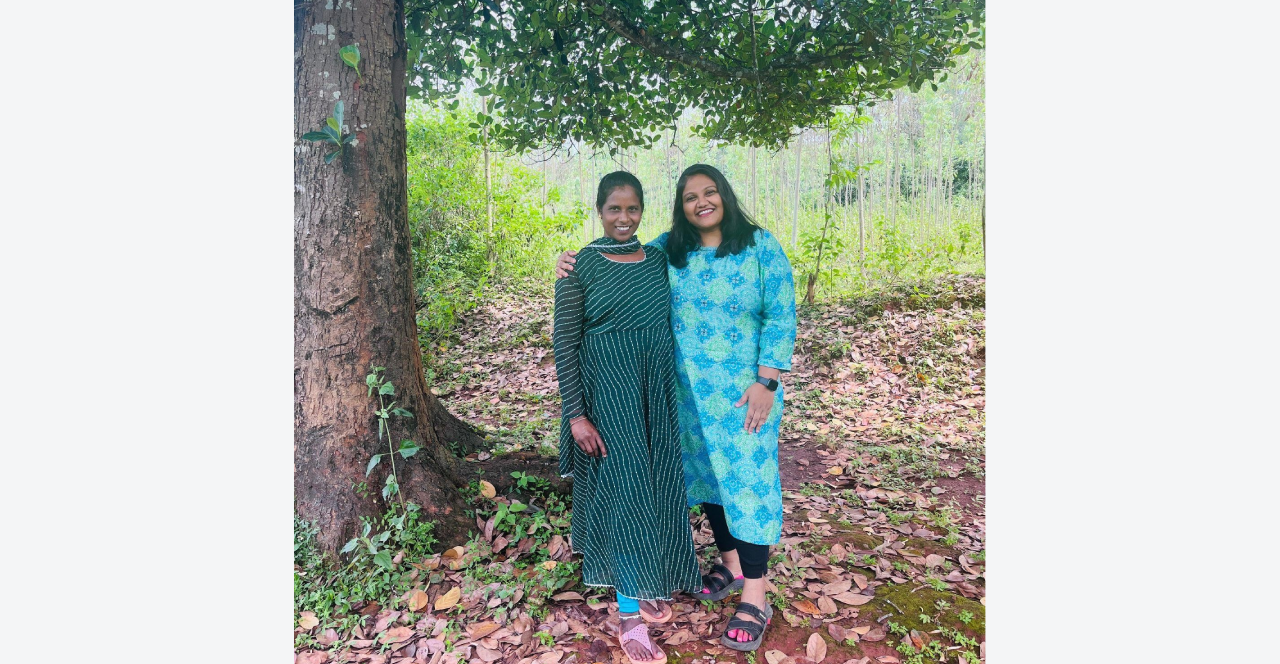
Photo: Rashita Sethy with Kumudei Khada
Her father had married again, simply because he wanted a son. From that point onward, she, her mother, and her sisters bore the consequences. The second wife made her mother’s life unbearable, while her father withdrew completely, abandoning every responsibility he once held.
While Kumudei’s younger sister was still in school, she found it to be a huge struggle to continue her own studies. She worked as a daily wage labourer, took tuitions, and somehow held her small family together. Weekdays were a blur of rushing between school and college; Sundays when the world rested, were spent doing hard labour to earn a few extra rupees.
Home, however, was never a place of comfort. Her father often returned drunk, raising his hand on her mother and, at times, even on her younger sister. Kumudei would try to intervene, to shield them, but nothing ever changed. Many nights ended in tears and exhausted silence. Sometimes, she told me, she wanted to run away and leave everything behind. But her mother’s endurance and her younger sister’s fragile dependence kept her anchored. She could not walk away. She had to stay. For them.
When she finished speaking, I remember sitting still, unable to form a sentence. I had seen her determination in the field, her eagerness to learn. Yet beneath that was a weight she had been carrying alone for years. It made me realise the kind of strength it takes to smile, work, and show up when your home itself is breaking you.
Amid all this chaos, she had heard about PRADAN and decided to take a chance. For the first time in her life, she earned something on her own. Something dignified. Something she did not have to hide her face to claim.
Moments That Changed Her. And Me.
Some memories remain as sharp as if they happened yesterday. One evening, she told me something so simple, yet so powerful, that it has stayed with me ever since.
“Didi, today I went to the haat with my own money. I bought vegetables for my home. My mother smiled so much. It felt like freedom.”
Her eyes shone with pride. It was such a small act; to buy vegetables but for her, it meant stepping into a life she had only watched from a distance. For the first time, she felt what autonomy tasted like. Working with PRADAN wasn’t just a job for her; it was the first door she had ever opened for herself. Working alongside other independent women stirred something within her. “If they can do it, why can’t I?” And with that question, she continued forward, one steady step at a time.
As weeks passed, I watched her confidence unfurl like a leaf finally catching sunlight. I still remember the way she walked into the office one evening, dust clinging to her saree but her face glowing. “Didi,” she said, almost shyly, “today I convinced the sarpanch of Dabuguda Panchayat about livestock training. He listened. He even promised to approve shed plans in the next Gram Sabha.”
With every conversation she braved, every hesitation she pushed through.
Her monthly salary, modest as it was, changed her world. She told me one afternoon, “my mother doesn’t have to go for labour work anymore. I even cleared a small loan. It feels lighter.”
Those earnings became the backbone of her family. She paid her younger sister’s college fees. She bought her mother a new saree on her first work anniversary. Over time, she bought a scooty for herself, learning to drive, getting a driving license, going from village to village working as a Master Trainer. She narrated these things with such joy that it was impossible not to feel it with her. These were not purchases; they were victories; small, personal, hard-won victories.

Photo: Kumudei with her scooty
Slowly, she left behind the exhausting labour work that had drained her for years. And as she stepped deeper into her role, recognition followed. People who once saw her only through the shadow of her father now approached her for guidance. They trusted her. They valued her. She was no longer shrinking under an identity imposed on her, she was crafting her own.
One day in a village, Sanakichab, I saw a version of her I had never seen before. The atmosphere was charged, villagers frustrated, voices rising. When Sumitra, another MT, was blamed for the death of poultry birds three days after vaccination, chaos erupted. Even the Livelihood Inspector (LI) added fuel, claiming she lacked confidence. Panicked, Sumitra called Kumudei.
But Kumudei didn’t step back. She didn’t rush to defend. She explained the role of MTs, checked shed conditions, feeders, drinkers, and management practices. She gathered data from other rearers vaccinated that same evening. She also involved the Block Veterinary Officer (BVO). When the post-mortem pointed to feed-related issues, she traced the leftover feed, examined the infected feeder, and located the expired feed packet responsible for the deaths. With clear reasoning, she helped the villagers see the truth. If vaccination had been the issue, every rearer would have suffered losses.
After the meeting, she turned to me and said, “Didi, it’s not about me. It’s about everyone we work with. If they succeed, we all succeed.”
Soon, villagers began approaching her mother and saying, “Your daughter has done what no one else could. She is helping us, guiding us, standing by us.” And it was true.
Kumudei had transformed.
Looking back, Kumudei speaks of a profound shift in her life. The path she chose, once filled with fear and uncertainty, had slowly begun to create value, not just by strengthening livelihoods, but by earning her dignity, respect, and recognition, both for herself and for her mother. Over time, even her father stopped questioning her choices, while community members increasingly turned to her for guidance and support.
“Today, I feel proud of what I have achieved. My mother is proud of me. My father has accepted me as an earning member of the family. This journey has been full of learning, and I am grateful to the community and to you for giving me the opportunity to prove myself,” says Kumudei, reflecting on the early days of her career.
Being able to move freely across villages without fear of judgment gave her a renewed sense of confidence and happiness. With each experience, she grew learning to mobilise people more effectively, build trust, and inspire collective action, strengthening her commitment to serve society.
Kumudei and her resilience
After five years of working with her, I often pause to reflect. Watching Kumudei’s journey unfold taught me that development is never just about programmes, trainings, or targets. It is about creating spaces where people begin to see themselves differently, where they become the writers of their own lives.
Kumudei changed the world around her. In many ways, she changed my world too. She taught me patience, the value of trust, and how even the smallest encouragement can unlock unimaginable courage.
There were moments when repeated setbacks in villages, where livestock rearing was still not readily accepted, left me disheartened. Each time, I returned to the office and shared my frustrations with her. She would remind me to be patient and to trust the process.
In one such village, where farmers had abandoned livestock rearing after facing mortality losses twice, we worked together to rebuild confidence. Slowly, we addressed similar situations across villages, supporting communities as they moved from denial to cautious acceptance. Beyond field mobilisation, we also explored local markets together, identifying better vendors and helping farmers secure fairer prices for their produce.
Amid training sessions and long field visits, she often spoke about how our work and our companionship had strengthened her self-belief and reshaped her life. What she did not realise was how deeply she had influenced me as well. Her journey deepened my respect and affection for her. I came to admire her not only for the work she did, but for the person she was.
When I think of the trembling young girl I first met, and the woman she is today, the transformation still astonishes me. The clarity with which she now envisions her life, the confidence with which she takes it forward, I could not have imagined then. Her growth has made me realise that when we invest in a person; not just professionally, but as a human being, the impact ripples far beyond any outcome we can quantify.
Many times, I have asked myself: Did I really change her life? And every time, the honest answer remains — I don’t know. But I do know that her growth has profoundly changed mine. Her resilience, her fire, the way she kept going despite every barrier, it has left an imprint on me that I will carry forever. Maybe this is the greatest privilege of being a development worker, to witness someone rise not because of what you did, but because you stood beside them long enough for them to believe in themselves.
Today, Kumudei earns around ₹12,000 per month, leading five Master Trainers and supporting nearly 5,500 families across the block. She has also renovated her home. She supports her younger sister’s career. She continues to care for her mother with pride instead of fear. She speaks with confidence to officials, villagers, and peers alike.
She has become a leader.
A mentor.
A force.
And an inspiration. Not only to her community, but to me.
About the Author