
A Night of Heroes and Harvest: An Observer’s Account of Hero Parab in Ho Community
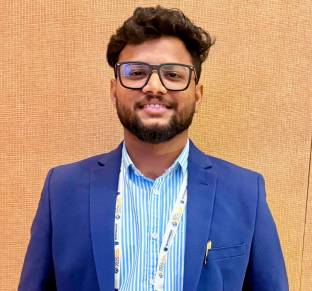
-Rittik Das, Executive, PRADAN
There is little written documentation on Hero Parab or on the everyday cultural life of the Ho community in Jharkhand. While trying to learn more about the festival, I found only fragments, passing references, brief mentions, and almost no first-hand accounts. This piece is not an expert’s explanation, but a learner’s record, shaped by observation and participation. If, someday, someone seeks to understand Hero Parab or the people who celebrate it, I hope these notes offer a small point of reference, a glimpse into a living tradition rooted in land, memory, and collective belonging.
Introduction
The first time I visited the field as a Development Apprentice in 2023, I thought I was there to learn about livelihoods. I didn’t realise I was also learning about myself. Trained in agricultural science, with a B.Sc. in Agriculture from Bidhan Chandra Krishi Viswavidyalaya in West Bengal, I arrived with an understanding of crop systems, soil health, and farm management, along with questions about how these ideas translate into everyday practice, how knowledge travels, how decisions are made, and how livelihoods are shaped on the ground.
Living in the village of Bamebasa in Chaibada district of Jharkhand, as part of my apprenticeship, I was introduced to the Ho community, a world that felt unfamiliar at first, yet strangely close to home.
I come from Purulia in West Bengal, a region shaped by forests, hills, and long histories of tribal life. Santhal, Bhumij, Sabar, and Munda communities have lived there for generations, sustaining rich cultural traditions and indigenous livelihoods. Growing up in this landscape, I was familiar with many of these practices and festivals, and they formed an important part of my cultural surroundings. Yet, my engagement with them remained uneven, rooted more in observation than in active involvement in their everyday life and lifestyle. That familiarity, I came to realise, did not amount to a complete understanding, nor did it prepare me for the distinct cultural world of the Ho community.
It was only after arriving here that I fully realised how layered and diverse tribal cultures are. Each community carries its own language, rituals, belief systems, and ways of organising everyday life. The Ho community, with its distinct language and cultural practices, was entirely new to me. It reminded me how easily familiarity can be assumed, and how much remains unseen even within landscapes we believe we already know. That realization was humbling.
Curiosity gradually drew me closer to the community. I wanted to speak with people, understand their lives, and become more than a visitor passing through. But language stood firmly in the way. Most of the women did not speak Hindi, and their words sounded like music I could not yet decipher. The Ho language; melodic, rhythmic, deeply expressive felt both beautiful and intimidating.
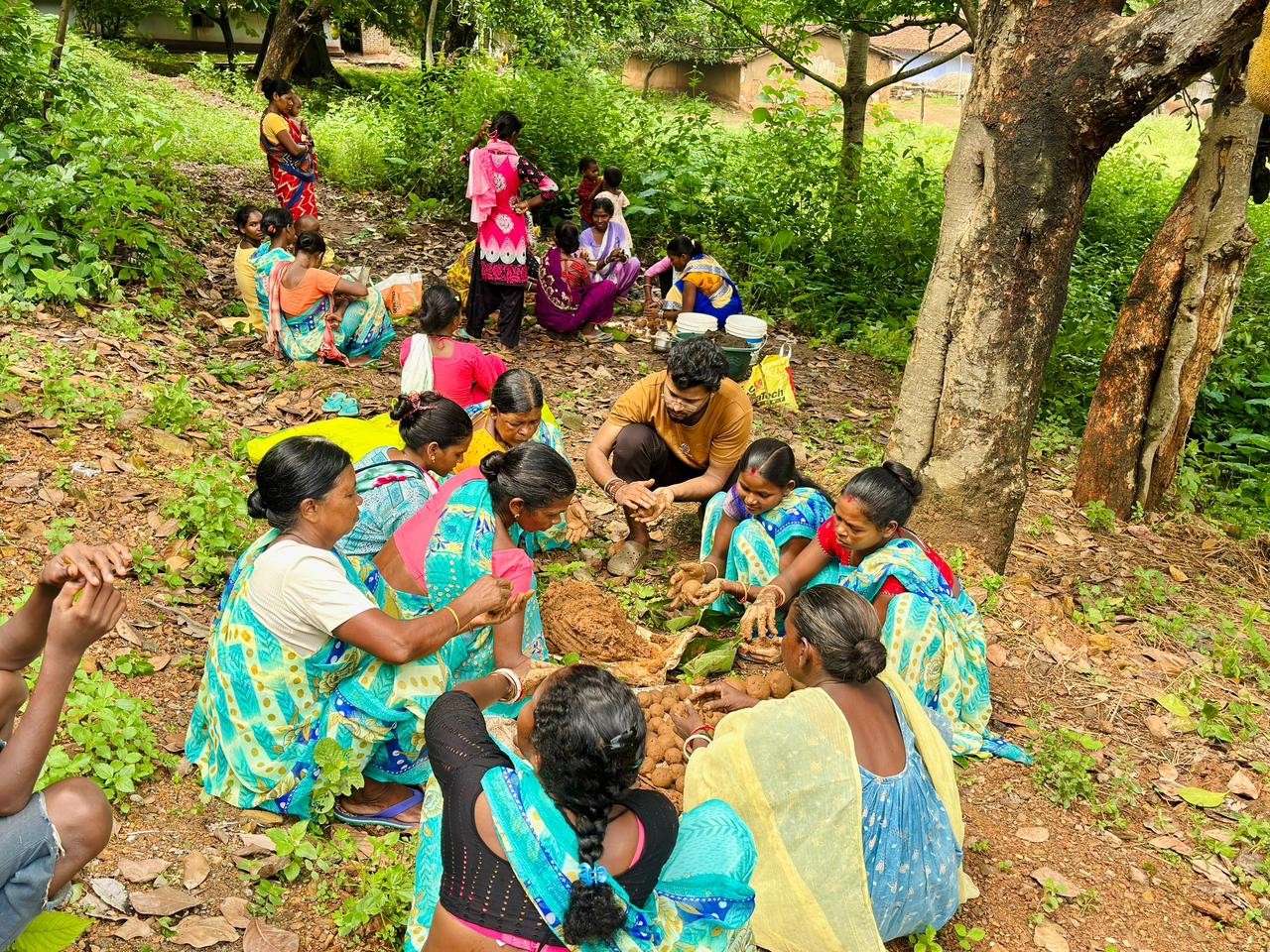
Photo: Rittik Das with the community members
As someone from a generation accustomed to solving problems through a quick search or translation app, I instinctively reached for my phone. But technology had little to offer. Ho, though recognised as a second language in Jharkhand and used in parts of Odisha’s education system, remains largely absent from mainstream digital translation tools. In that moment, I realised that not everything can be bridged through algorithms. And in that struggle, I began to understand something important: communication does not always depend on words alone.
Day to day life in the Ho Community
Daily life of the Ho community in villages unfolds with discipline shaped by necessity, tradition, and the rhythm of the land. Women begin their day before sunrise, often around five in the morning. Their mornings are spent cleaning the house and courtyard, frequently using mud to smoothen the floors before walking long distances to fetch water from hand pumps or nearby rivers. Once back, they prepare simple meals for the family, usually rice accompanied by saag, and then move on to agricultural work. Women are deeply involved in sowing seeds and harvesting crops, carrying much of the physical labour that sustains both household and farm. Yet there is a clear boundary: women do not touch the plough. That task, firmly governed by custom, remains the responsibility, or should I say the privilege of men.
Men, in turn, take on work that is considered heavy or outward-facing. Early mornings are spent ploughing the fields with bullocks, preparing the land for cultivation. During periods when farm work is scarce, many travel to nearby towns in search of wage labour, while continuing to care for livestock such as cows and goats. Evenings often draw the men together to the village centre, where they discuss community matters, resolve disputes, and relax over Handiya, the traditional rice beer. These gatherings are not merely social; they are spaces where decisions are made and collective life is negotiated.
Children grow up immersed in this shared rhythm of work and play. Much of their childhood unfolds outdoors, surrounded by forests and open fields, with football emerging as a favourite pastime for both boys and girls. Alongside play, children contribute to household responsibilities, young girls often help their mothers with cooking and chores, while boys take goats out for grazing. Although many attend school, the agricultural calendar continues to shape their lives, and during harvest season, some miss classes to support their families in the fields.
Observing this division of labour, I found myself reflecting on how deeply roles are woven into everyday life. The boundaries between men’s and women’s work are clearly defined, accepted, and rarely questioned within the community. What surprised me was this contrast. In contemporary discourse, we often speak of gender boundaries blurring, especially in urban spaces. Tribal communities, too, are frequently described as more egalitarian in comparison to mainstream caste societies. Yet, on the ground, I encountered a structured division of labour that felt both stable and unquestioned. Sitting with these contradictions reminded me that understanding a community requires patience, humility, and a willingness to see beyond one’s own frameworks.
Getting closer with the community. And myself.
For the past two years, I have been living in this region, working closely with tribal and underserved communities in Chaibasa, West Singhbhum district of Jharkhand. My work focuses on fostering sustainable livelihoods, strengthening women’s collectives, and nurturing grassroots leadership. Over time, I have grown accustomed to the rhythm of life here, one that moves at a pace very different from the cities I once found familiar.
When people ask me what this work looks like, whether it is an office job or merely a series of field visits, I often struggle to answer in a single sentence. It is neither about sitting in air-conditioned cabins nor about charity in the conventional sense. It is about applying agricultural science where it is needed the most, translating policy into lived practice, and, above all, building trust with communities. Development work unfolds slowly, through conversations, shared labour, and everyday presence. It demands patience as much as expertise.
Gradually, the noise of traffic, crowded malls, and the constant rush of urban life has begun to lose their appeal. Each visit to the villages brought a sense of calm. The warmth of people’s greetings, their ease with one another, and the continuity of everyday life offered a kind of steadiness I had not realised I was missing.
The community received me with openness and respect. Their lives are shaped by constraints I cannot ignore, yet what struck me the most was the depth of collective belonging. Whether celebrating a festival or mourning a loss, the instinct was always community first, self later. Joy was shared. Grief was shared. Decisions were rarely individual; they were woven into a larger fabric of relationships.
I realised how differently I had been conditioned. I come from a world that often prioritises the “I”, individual ambition, personal milestones, private definitions of success. Here, success seemed less about accumulation and more about continuity: of land, of relationships, of shared responsibility. Comfort was not excess; it was security. Fulfilment was not achievement alone; it was participation.
Being present in this space unsettled some of my assumptions about independence, progress, and what it means to live well. In drawing closer to the community, I found myself becoming more attentive, more patient, and, unexpectedly, more grounded.
Work and New Experiences.
In the beginning, communication was difficult. I relied on gestures, smiles, and, at times, the help of children who knew a little Hindi. Conversations unfolded slowly, often awkwardly, but they carried patience on both sides.
Slowly, I began to pick up words, one at a time. Now I can proudly say, “अनिया नुटुम Rittik Das” (My name is Rittik Das) and “अनिया हाटू दो Purulia” (My hometown is Purulia). That’s progress, right?
Gradually, I realised that communication extends far beyond words. Even without complete linguistic understanding, a connection took shape built through shared work, everyday presence, and mutual familiarity. The women joke with me, tease me like their own son, and draw me into their laughter and routines. Much of what we share happens without language at all, unfolding through gestures, glances, and moments of silence.
As a professional, my work often revolves around reports, outcomes, and measurable change. But as a person, it is these moments, being invited to festivals, attending weddings, cheering at local sports events that truly anchor me here. These shared experiences have deepened my relationship with the community, and in doing so, have made my work feel more grounded, more honest, and more meaningful.
From Work to Belonging
Over time, my relationship with the community grew in both practical and emotional ways. Our bonds were formed through conversations, shared labour, and the small routines of everyday life. My engagement gradually extended beyond reports and meetings; it became about presence. I found myself joining the community during festivals, weddings, and even weekly sports events. These moments of companionship strengthened our relationship, and the trust that emerged made my work more grounded and effective.
Over time, the villagers began to treat me as one of their own. I visited often, sometimes for meetings, sometimes to review progress, and sometimes simply to spend time together. One village, in particular, came to hold a special place in my life—Hathimanda. Working closely with the community there on regenerative agriculture and integrated farm models deepened our connection. Their willingness to place their trust in me, to guide and support their livelihood efforts filled me with both pride and a deep sense of responsibility.
One afternoon, after a meeting had ended, three women; Malin Tubid, Sumati Tubid, and Jharna Tubid approached me with warm smiles and said, “दादा, परब है, आप आइएगा; नाच कीजिएगा और मीट खाइएगा।” (“Brother, it’s the festival; you must come, dance, and relish mutton with us.”)
Their invitation filled me with joy. It felt less like a request and more like an inclusion, as though I had been folded into the fabric of their lives. That evening, after finishing my work, I reached the village around five o’clock. The festival was being celebrated in a forest clearing, a space alive with music, movement, and laughter.
The celebration felt like an ode to nature, a collective prayer of gratitude. Watching the rituals unfold brought a sense of calm. I accepted the mutton offered as prasad with reverence and later visited Malin didi’s home, where she served me another serving of mutton with roti and pooris. We ate together, laughed, and danced for a while. When I returned to Chaibasa that night, I carried with me the warmth of their affection and a feeling of belonging.
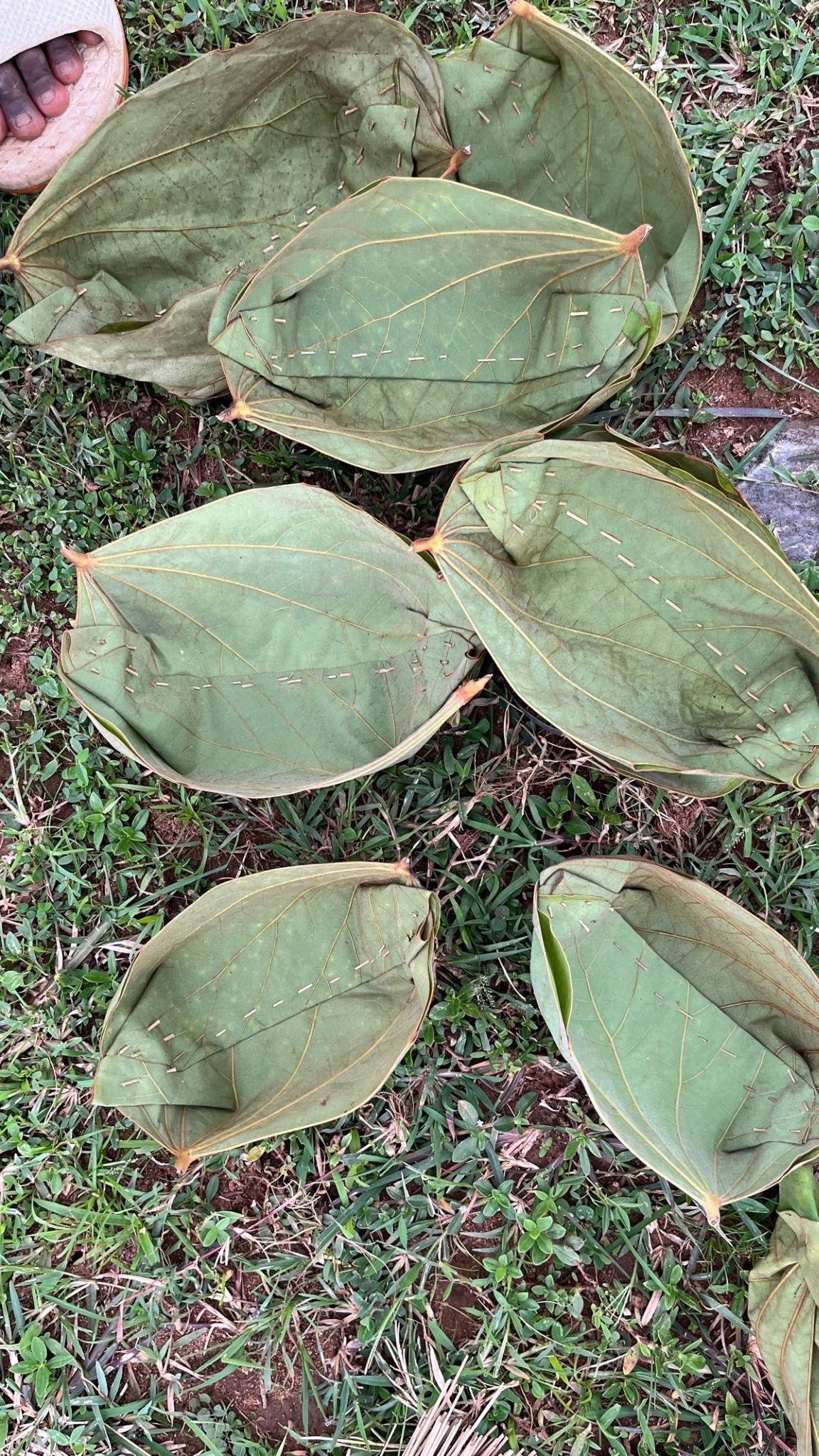
Photo: Plates prepared by the community for the distribution of prasad
Hero Parab: Meaning and Memory
Hero Parab, also known as Hero Porob, is one of the most significant festivals of the Ho community. Celebrated annually on the full moon night of Ashadh (June–July), it is both a ritual of remembrance and a collective act of gratitude. Observed across the Ho-inhabited regions of Jharkhand, Odisha, and West Bengal, the festival holds deep cultural and historical meaning for the community.
At the heart of Hero Parab lies the story of Lita, a revered ancestral hero remembered for his courage and devotion. According to folklore, Lita risked his life to retrieve his father’s body from a mythical creature, an act that came to symbolise bravery, filial duty, and respect for the land. Through this narrative, the festival honours not only Lita, but generations of ancestors whose lives were shaped by struggle, resilience, and an enduring relationship with nature.
Hero Parab also coincides with a crucial moment in the agricultural calendar. After the worship rituals are completed, the community re-ploughs the paddy fields to remove weeds, a practice that marks renewal and preparation. This act is both practical and symbolic, reflecting the community’s belief that agricultural labour, ancestral blessings, and ecological balance are deeply interconnected. The festival, in this sense, becomes a bridge between memory and sustenance, ritual and livelihood.
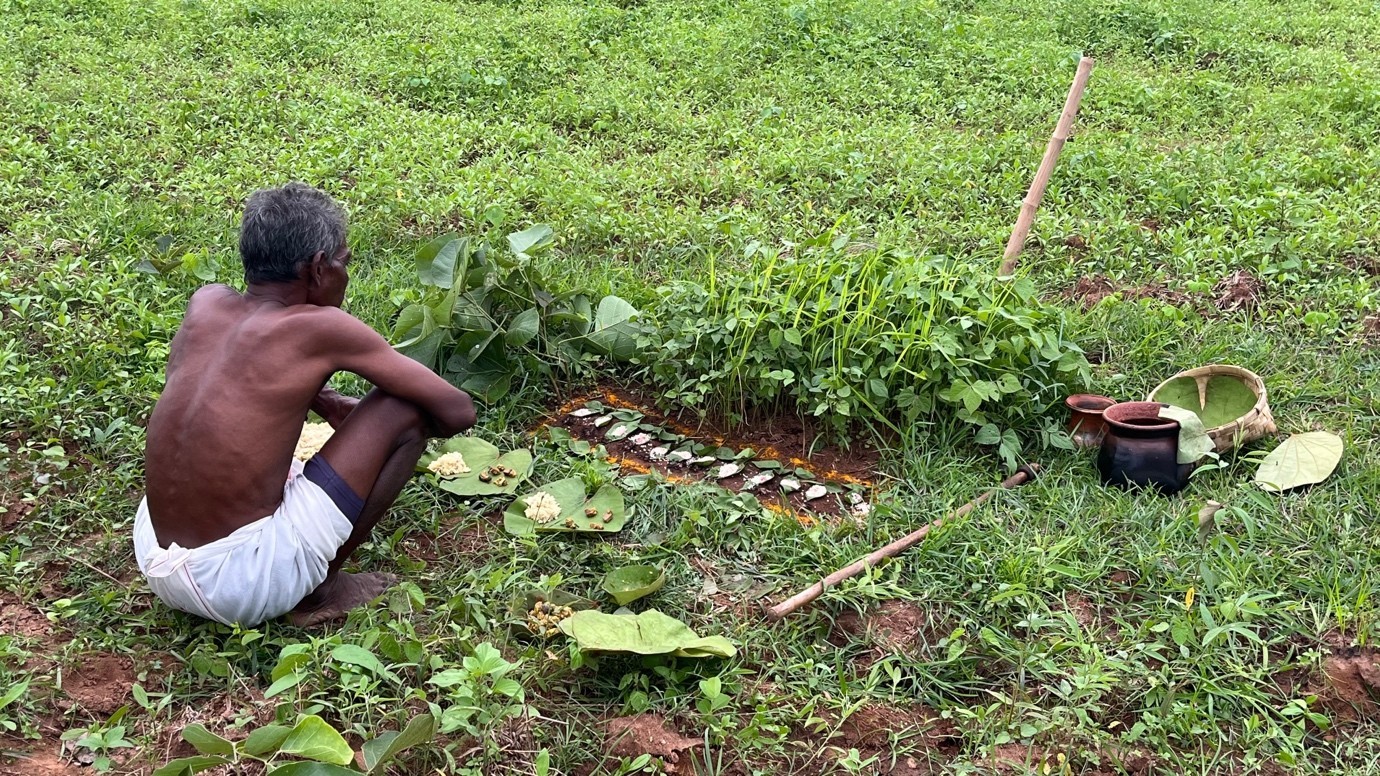
Photo: Offering prayers during the festival of Hero Parab
Rituals, Practice, and Celebration
On July 19, 2025, I witnessed the rituals of Hero Parab for the first time. By mid-afternoon, around three o’clock, the men of the village had gathered for the puja. In keeping with custom, women did not participate in the ritual directly. The village priest led the ceremony, offering rice, turmeric, green leaves, and sacred mud pots, along with the traditional sacrifice of a goat. The prayers were simple and direct, seeking timely rainfall, a good harvest, and peace for the ancestors. Standing there, I sensed a quiet continuity, an unbroken line connecting the land, the people, and those who came before them.
Once the puja concluded, the atmosphere softened. The solemnity of prayer gave way to conversation and shared laughter. The cooked meat was distributed as prasad, and people sat together to eat, drinking Handiya. The act of eating together felt central to the celebration not as an event, but as a reaffirmation of community.
As night fell, the energy shifted again. Around nine o’clock, the men gathered at the ankhra, the village’s open dancing ground. The sound of the Dama and Dumi drums—one deep and resonant, the other sharper and quicker filled the air. The rhythm was steady and compelling. One by one, the men began to dance, their movements grounded and deliberate, illuminated by firelight. Watching them, I felt drawn in not in spectacle, but in attention.
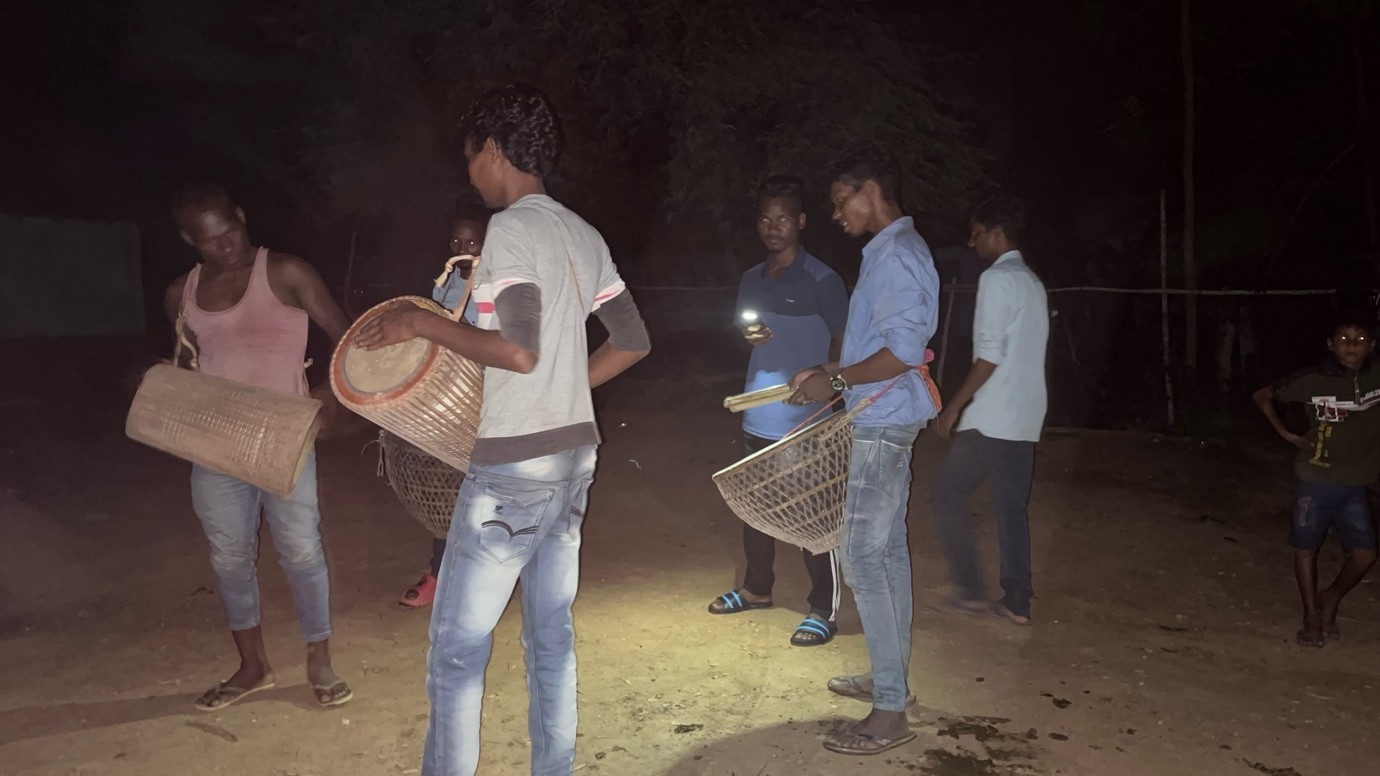
Photo: Men dancing with the rhythm of Dama and Dumi Drums
The celebration felt markedly different from gatherings in urban spaces I was familiar with. There was no sense of display or performance. Everything was simple, unforced, and deeply collective. The dance was not entertainment alone; it carried stories of ancestors, land, struggle, and continuity. Eating together, laughing, and moving in rhythm came naturally. When someone called out, inviting me to join the dance, it felt less like a gesture and more like acceptance.
Although I come from Purulia and am not unfamiliar with tribal cultures, this experience felt new. Watching the entire village celebrate together brought a sense of calm and clarity. It reminded me that joy does not require excess, that it often grows from shared presence, mutual care, and the quiet strength of community. Hero Parab, I realised, is not merely a festival. It is a living expression of who the Ho people are, renewed each year through ritual, labour, and togetherness.
Across Landscapes, a Shared Spirit
Coming from Purulia in West Bengal, I could not help but compare Hero Parab with the festivals I grew up witnessing at home—celebrations such as Tusu and Karam, which are also deeply tied to agriculture, nature, and seasonal cycles. The rhythms of the drums here in Chaibasa felt familiar, reminding me of the Chhau performances of Purulia, where movement and music are not merely forms of entertainment but carriers of memory and tradition. In both places, the entire village eats together, reinforcing a sense of collective belonging that feels central to tribal celebrations across regions.
At the same time, the differences were striking. In Purulia, women often take on visible and leading roles during festivals; singing, organising, and sometimes guiding the rituals themselves. During Tusu Parab, for instance, women are at the centre of worship. In contrast, during Hero Parab, women do not enter the ritual space. Initially, this absence unsettled me. Over time, I came to understand that women participate in ways that remain largely unseen: preparing ritual materials, carrying offerings to the puja site, and observing fasts alongside their husbands until the rituals are complete. There are also strict rules around prasad. On this day, women do not consume the sacrificial meat or drink Handiya. These practices are shaped by belief, responsibility, and a deep sense of collective care, even if they differ from what I am accustomed to.
I also realised something more personal: had I been a woman, my experience of the festival would have been entirely different. I would not have stood inside the ritual space as freely as I did. I would have carried the responsibility of observing the prescribed rituals and boundaries. That awareness made my position feel both privileged and partial.
Food, too, marked a difference. In my village, rituals are often accompanied by vegetarian offerings and sweets such as pitha, while in the Ho community, the sacrifice of a goat and the sharing of meat are central to the ritual itself. The rules around participation and prasad here felt stricter, more clearly defined. Yet, beneath these differences, the spirit remained the same. Across both landscapes, festivals serve as moments of pause, when people come together to honour the land, remember their ancestors, and reaffirm bonds with one another. Witnessing Hero Parab allowed me to recognise that while traditions may vary in form, the values of gratitude, togetherness, and continuity run deeply through them all.
Lessons That Continue
Spending time with the Ho community reminded me that there is no single way to understand “tribal culture.” What may appear familiar at first reveals its depth only with time, attention, and participation. It is through everyday moments; celebration, labour, silence, and even discomfort that one slowly moves from being an observer to becoming, in some measure, part of the community.
In sharing space with them, I began to understand not only their visible realities but also the emotional weight of their struggles and the strength of their joys. Their experiences no longer felt distant or academic; they became personal. A subtle but powerful sense of oneness emerged.
This shift deeply shaped me as a development professional. I no longer remained an outsider engaging with “beneficiaries” from a distance. The development processes I became part of, whether related to livelihoods, institutions, or social change stopped feeling like projects to be implemented. They began to feel like shared journeys. The questions were no longer about delivering outcomes, but about walking alongside people whose lives were directly affected by these processes.
Understanding, I realised, is not something one arrives at fully. It is shaped gradually through listening, unlearning, and allowing everyday encounters to leave their mark. As I continue this journey, I remain aware that what I have witnessed is only a fragment of a much larger world, one that deserves patience, respect, and the humility to keep learning.
About the Author